The “moles” digging the M6 metro: how a TBM builds the tunnel, ring by ring

The “moles” of M6 Metro Line dig the earth, bring it to the surface and build the tunnel behind them, almost simultaneously. Their technical name is TBM, from Tunnel Boring Machine.

The TBMs “Sfânta Maria” and “Sfânta Ana”, which are working on the SOUTH Section of M6 Metro Line, weigh around 600 tonnes and have cutterheads roughly 6.60 metres in diameter. In length, they come close to a football pitch. They enter the ground, and behind them they leave a circular, reinforced tunnel, ready for the next stages.

The front of the TBM carries the cutterhead, a huge metal disc fitted with cutting tools. It rotates, breaks up the ground and pushes the material into a chamber where the pressure is controlled at all times. The pressure keeps the excavation face stable and allows the machine to advance under control. From there, the material travels onto a screw conveyor, then onto conveyor belts, and out of the tunnel. It is loaded up and taken to authorised sites.

While digging goes on at the front, the tunnel is already being assembled behind the shield.

Segments and tunnel rings

The TBM advances using hydraulic rams that push against the last ring installed. After each advance, an erector lifts the segments, the precast concrete elements, and sets them side by side until a new ring is closed. A gap remains between the concrete ring and the ground, which is filled by injecting a special grout known as bentonite. The operation fixes the structure in place and helps stabilise the surrounding ground.

Then the cycle begins again: excavate, remove the material, advance the machine, install a ring, inject the grout. And so it goes, a few metres a day, month after month.

How the “mole” knows where to go

Tens of metres underground, orientation has nothing to do with instinct. The TBM has guidance systems, sensors and survey reference points tied to the project coordinates. The operators follow the alignment constantly and can correct the direction with very precise adjustments. From the control cabin they monitor, in real time, the pressure in the excavation chamber, the amount of material extracted and the position of the machine in relation to the designed axis. The operating parameters of the cutterhead and of the hydraulic systems, as well as the operations involved in fitting the rings are added to these are.

Under standard conditions, the TBMs on the SOUTH Section of M6 Metro Line in Bucharest advance at an average speed of approximately 1.5 metres per hour. It doesn’t seem like much, until you see what happens during that hour: the machine excavates around 60 cubic metres of material and prepares for the installation of the tunnel’s permanent structure.

An average of 13 to 14 rings are installed in 24 hours. The teams work in three shifts and the activity is continuous, with the breaks as required for checks and maintenance. The pace varies according to the ground, the recorded parameters and the maintenance work.

Romania’s “moles”: from the metro to tunnels through the mountains

TBM technology is not being used in Romania for the first time. On M5 Metro Line in Bucharest, the excavation was carried out by “Sfânta Varvara” and “Sfânta Filofteia”.

On the Brașov – Sighișoara railway line, on the Apața – Cața subsection, four TBMs are at work, “Eleni”, “Varvara”, “Alexandra” and “Konstantina”, on the Ormeniș and Homorod twin tunnels. The railway machines have a different diameter and work in different geological conditions, but the principle is the same: controlled excavation, removal of the material, immediate installation of the structure and monitoring of the parameters.

The names follow a long tradition in tunnelling projects. Saint Barbara is regarded as the protector of miners and of those who work underground. On M6 Metro Line, the tradition continues with “Sfânta Maria” and “Sfânta Ana”.

What happens at the surface

Although the activity takes place underground, the operation of the TBM is backed by an extensive monitoring system. The pressure in the excavation chamber, the amount of material extracted, the route of the machine and the soil characteristics are checked at all times. In the areas within the zone of influence of the works, special equipment is used to monitor the ground and the buildings.

The underground route to the airport

M6 Metro Line will have 14.2 kilometres of double track and 12 stations, and will create the first direct metro connection between Gara de Nord and Henri Coandă International Airport.

The video shows how the machine advances and how the concrete segments become, ring by ring, the structure of the future tunnel.

Press “Play” and step inside a TBM for a few minutes.
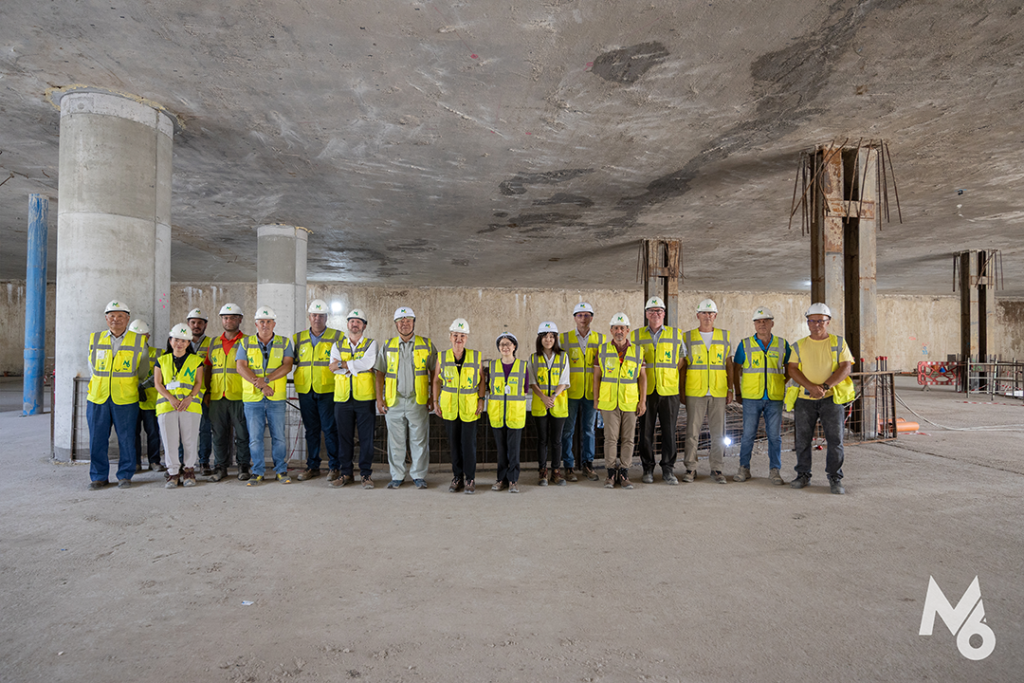
JICA monitoring mission on M6 Metro Line, an investment with government, European and Japanese funds

Between 17 and 19 August 2026, the Japan International Cooperation Agency (JICA) carried out a new mission in Bucharest to monitor the project co-financed through the ROM-P5 loan agreement for M6 Metro Line.


“Bucharest International Airport Rail Access Link Project (Metro Line 6. 1 Mai – Otopeni)” is a project of considerable local relevance, with a significant regional and international impact.

On behalf of JICA, one of the strategic funders of the M6 project, the delegation was led by Ms Hiroko Amano, Deputy Director within the Europe Division of the Department for the Middle East and Europe. During the visit, the JICA delegation held working meetings with representatives of the Ministry of Transport and Infrastructure, the Ministry of Finance, the Embassy of Japan in Romania, the supervisor, the contractors for Lot 1.1 and Lot 1.2, appointed for the design and build of the civil works, and the contractor for Package 2, appointed for the design and execution of the architectural works, railways, electromechanical and low-current installations.

The agenda of the mission included progress meetings to review the status of the project’s implementation and to secure the necessary budget allocations, as well as site visits. The Metrorex team, coordinated by Director General Mariana Miclăuș, presented the status of the works on the sites of the future M6 Metro Line. During these visits, the progress achieved and the next stages of the project were reviewed. In order to strengthen safety management in construction, the JICA mission paid particular attention to occupational safety, organising a seminar on the subject.

“Bucharest International Airport Rail Access Link Project (Metro Line 6. 1 Mai – Otopeni)” is a public utility project of national interest, in accordance with Government Decision no. 496/2017, as subsequently amended and supplemented, which addresses people’s mobility needs through the development of the trans-European transport network (TEN-T). The design and execution of the North Section of the new M6 Metro Line is financed from the state budget and from refundable external funds, through the external loan granted by JICA (Japan International Cooperation Agency).

The dialogue reconfirmed the importance of the strategic Romanian-Japanese partnership and the shared commitment to developing the BUCHAREST INTERNATIONAL AIRPORT RAIL ACCESS LINK PROJECT (METRO LINE 6. 1 MAI – OTOPENI) infrastructure project, a major investment landmark that is representative of the successful partnership between the two countries.

Temporary traffic restrictions in the area of the future Washington Station of M6 Metro Line

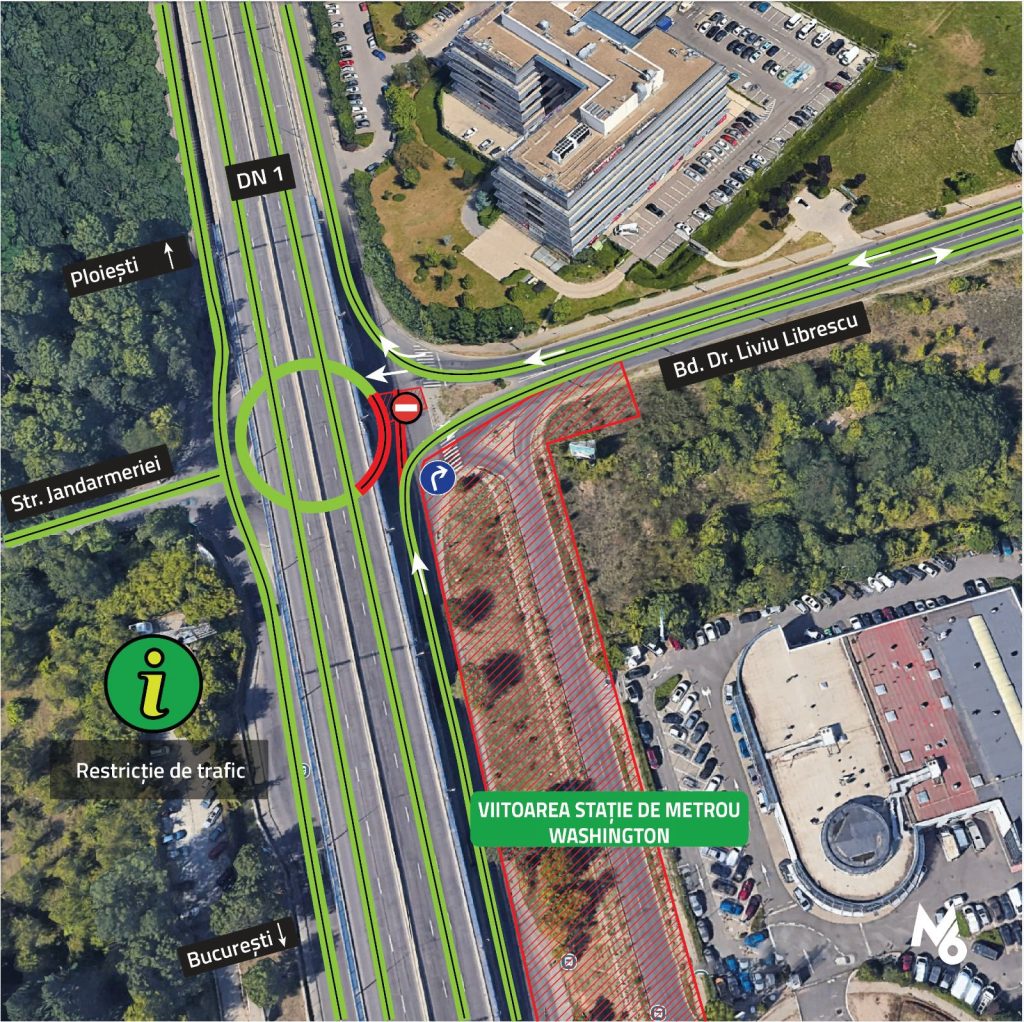
Starting on the night of 13/14 July 2026, a new stage of temporary traffic restrictions comes into force in the area of the junction between Șoseaua București – Ploiești (DN1) and Jandarmeriei Street, required for the utility relocation works for the future Washington Station of M6 Metro Line.

The following traffic restrictions will apply during this stage:
• the left turn from Jandarmeriei Street towards Otopeni is closed;
• straight-ahead movement on the Bucharest exit slip road of the Jandarmeriei overpass is closed.

The restrictions are imposed on the basis of the joint approval issued by C.N.A.I.R. and I.G.P.R., valid until 31 December 2026, with the possibility of an extension depending on how the works progress.

Traffic participants are asked to drive carefully, to observe the temporary road signs and to use the alternative routes indicated in the area.

We apologise for this inconvenience and thank all traffic participants for their understanding and cooperation.

Updated information on the progress of the works and on traffic restrictions will be published periodically on the official website of the project and on the communication channels of M6 Metro Line.

From university lecture halls to Romania’s major infrastructure projects

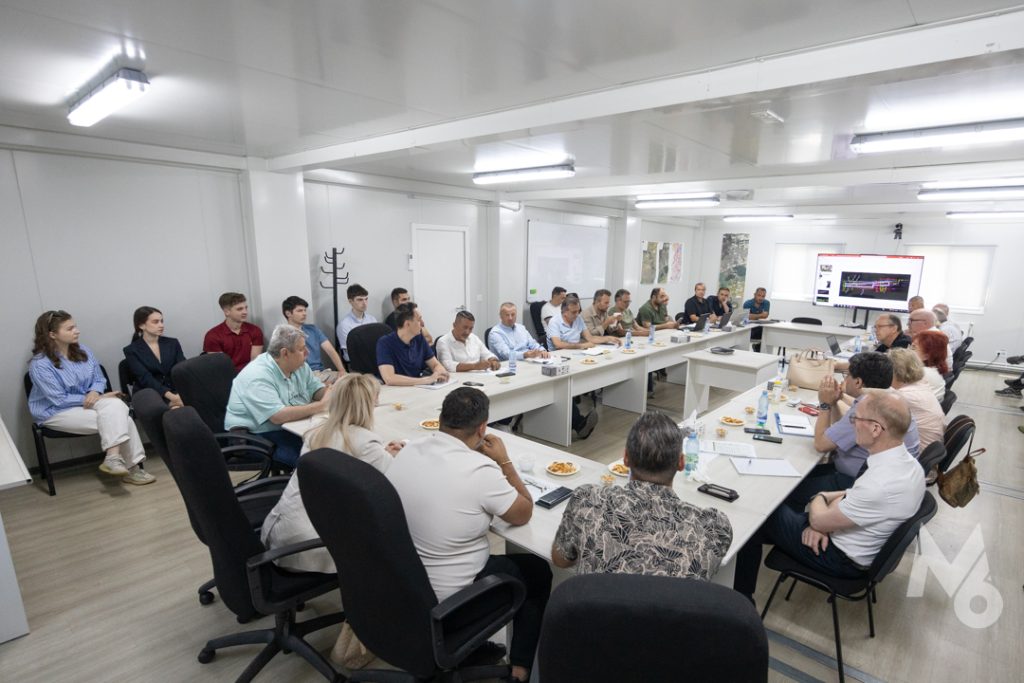
At the initiative of the Ministry of Transport and Infrastructure, in partnership with Metrorex, a group of future specialists took part in a progress meeting dedicated to the M6 Metro Line project, alongside representatives of the beneficiary, the contractors and the consultant supervisor.

The participants, whose educational background covers fields such as law, transport, public administration and business, had the opportunity to observe how the stages of a large-scale infrastructure project are coordinated, and to understand, directly from experienced professionals, the planning, collaboration and management processes required to implement a strategic investment.

The meeting provided a framework for dialogue between academic community and the specialists involved in implementing the project, highlighting the importance of practical experience in complementing theoretical knowledge and in training the next generation of infrastructure professionals.

Such initiatives help to strengthen the collaboration between public institutions and universities, giving young people the opportunity to understand the challenges and responsibilities involved in implementing complex projects that have a direct impact on the development of communities and on urban mobility.

Closer to the city, closer to the future: how M6 Metro Line brings people nearer to their opportunities

For a family in Otopeni or in the north of Ilfov county, the journey to Bucharest is not just a few kilometres on a map. It means mornings spent in traffic, time lost on the road, less hours with the family and, sometimes, opportunities that are harder to access.

That is why sustainability is not just about cleaner air, lower emissions or more efficient technical solutions. It means easier access to work, to school, to services and to the places where everyone builds their future.

Seen in that light, M6 Metro Line is more than just a metro line. It is a new connection between communities and the city, between home and workplace, between school and family, between the present and tomorrow’s opportunities.

Commuting is not just lost time

The daily journey to work or to school has a greater impact than it might seem at first sight. A study carried out by researchers Raj Chetty and Nathaniel Hendren at Harvard University, based on data from around 40 million people, has shown that commuting time is one of the most important factors associated with the chances of social mobility. The conclusion is that when people have access to reliable, predictable and affordable transport, they are more likely to secure better jobs, access education and essential services.

The same idea is also supported by mobility experts. The International Transport Forum, part of the OECD family, emphasises that the role of transport is to bring education, healthcare, jobs and everyday activities closer to people.

Quality transport does more than simply move people from one place to another. It gives them greater freedom of choice. It makes everyday life easier. It opens up routes that might otherwise seem too long or too difficult to travel.

A young community, growing fast

The area around M6 Metro Line is one of the most dynamic in Romania. Between the 2011 and 2021 censuses, Ilfov County recorded one of the highest population growth rates in the European Union, at around 40%. At the same time, Ilfov is the youngest county in Romania, with an average age of 38.6 years.

Behind these figures are people: young families, children, parents who work in Bucharest, pupils and students who commute every day, growing communities that need better connections with the city.

However, this development also brings challenges. More and more people are travelling between Ilfov and Bucharest every day, and the roads are becoming increasingly congested. For a pupil attending secondary school in the capital, for a student, or for a parent who works in the city, every hour spent in traffic is an hour taken away from their personal time, their leisure time, and their family life.

How M6 is making a difference to the community

This is where M6 Metro Line comes in. On the North Section, Lot 1.2 Tokyo – Aeroport Otopeni, the new metro line will connect the northern area of the capital and the town of Otopeni with the Bucharest metro network and with Henri Coandă International Airport.

Stations such as Bruxelles, Otopeni, Ion I.C. Brătianu and Aeroport Otopeni will bring high-capacity public transport closer to the communities that need it daily.

For the people living near the metro line, this means greater predictability. A teenager will be able to reach secondary school or university more easily. A parent will be able to get to work without depending constantly on the car or on road traffic. A family with a single car, or with no car at all, will have more options.

It also means more equitable access to opportunities. Because when public transport becomes more accessible and efficient, opportunities no longer depend so much on distance, traffic or whether or not one owns a car.

More than transport

The benefits of a metro line do not stop at the time saved on the journey. Modern transport infrastructure can support the development of the areas around the stations, encourage new services to appear, attract investments and connect the communities better.

Over time, the areas around the stations can become livelier, more accessible and better integrated into city life. Places where people do not just pass through, but live, work, learn and make plans.

A metro that brings people closer

M6 Metro Line is not just an investment in infrastructure. It is an investment in saved time, in easier access, in mobility and in better chances for the community.

Through this new link with Bucharest and with Henri Coandă International Airport, people in the northern area of the capital and in Otopeni will be closer to the places where they work, study and build their future.

Today we are building the infrastructure that will bring tomorrow communities closer to their opportunities. Because a sustainable city is, above all, a city in which people can reach one another more easily.

A delegation from Cluj-Napoca City Hall on a working visit to the construction site of M6 Metro Line

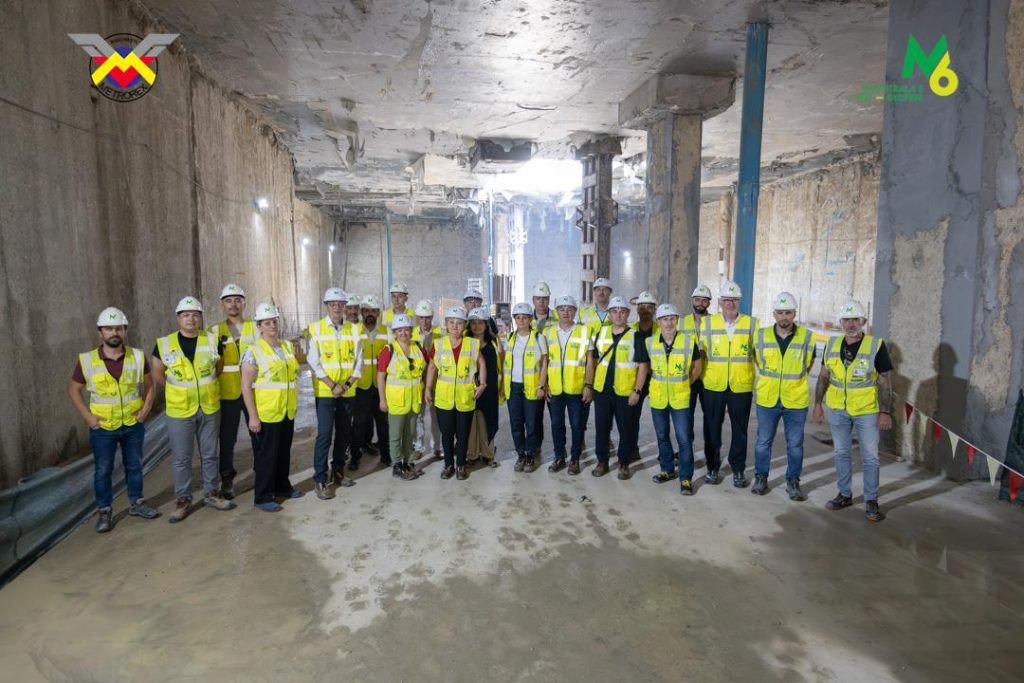
A delegation from Cluj-Napoca City Hall, involved in the implementation of the metro project in Cluj, paid a working visit today to the construction site of M6 Metro Line in Bucharest, as part of an exchange of expertise focused on metro infrastructure projects.

During the visit, representatives of Metrorex, of the Contractors and of the Consultant supervisor presented the current status of the works, the way the site is organised and managed, and the experience gained in the implementation of an infrastructure project of great complexity.

The discussions covered the exchange of good practice, the challenges encountered in the course of the project and the technical and organisational solutions applied in carrying out the works.

The programme also included a visit to the construction site of the future Piața Montreal metro station, where the delegation had the opportunity to see the progress of works and the main activities currently underway.

Such meetings help to strengthen collaboration between the teams involved in the development of metro projects in Romania and facilitate the transfer of knowledge and experience between specialists, for the benefit of the development of urban transport infrastructure.

M6: Ongoing works and temporary traffic changes

M6 Metro Line will enable the first direct, fast connection between Gara de Nord and Henri Coandă International Airport. The new line will have 14.2 km long with double-track rail and 12 stations, serving key areas of the capital and the city of Otopeni: 1 Mai, Romexpo, Gara Băneasa, Aeroport Băneasa, residential, commercial, and business areas along DN1, and Henri Coandă International Airport.

During this period, complex construction works, including the execution of underground structures and the relocation of utility networks are currently being carried out along the entire route of M6 Metro Line. To ensure these activities are carried out safely, temporary traffic restrictions have been implemented in certain areas along the project’s two sections—South and North.

Below are the main works currently carried out and the areas where they affect traffic.

As certain projects are completed, traffic management is adjusted to minimize the impact on urban mobility.

SOUTH SECTION

🟢1 MAI Station 🏗️ Utility relocation, diaphragm walls | 📍 Restrictions/diversions: Calea Griviței – Ion Mihalache Blvd.

🟢PAJURA Station 🏗️ Station structure, accesses | 📍 No impact on traffic

🟢EXPOZIȚIEI Station 🏗️ Station structure, accesses | 📍 Restrictions/diversions: Expoziției Blvd.

🟢EXPOZIȚIEI – PIAȚA MONTREAL interstation 🏗️ Utility relocation | 📍 Restrictions/diversions: Expoziției Blvd. – Aviator Popișteanu Street

🟢PIAȚA MONTREAL Station 🏗️ Station structure, accesses | 📍 Restrictions/diversions: Mărăști Blvd.

🟢PIAȚA MONTREAL – GARA BĂNEASA interstation 🏗️ TBM tunnelling, utility relocation | 📍 No major impact on traffic

🟢GARA BĂNEASA Station 🏗️ Utility relocation, accesses | 📍 Restrictions/diversions: Șos. București-Ploiești (Fântâna Miorița)

🟢GARA BĂNEASA – AEROPORT BĂNEASA interstation 🏗️ Utility relocation | 📍 Restrictions/diversions: DN1 – Elena Văcărescu Street and Dobrogeanu Gherea Street

🟢AEROPORT BĂNEASA Station 🏗️ Utility relocation, accesses | 📍 Restrictions/diversions: Grațioasa Street, DN1 – Aerogării Blvd.

🟢AEROPORT BĂNEASA – TOKYO interstation 🏗️ Utility relocation | 📍 Restrictions/diversions: Selgros slip road

🟢TOKYO Station 🏗️ Station structure, accesses | 📍 Restrictions/diversions: DN1 slip road (towards Bucharest), Pană Buescu Street

NORTH SECTION

🟢WASHINGTON Station 🏗️ Utility relocation | 📍 Restrictions/diversions: Jandarmeriei Street – Dr. Liviu Librescu Blvd., DN1 slip road

🟢PARIS Station 🏗️ Utility relocation, diaphragm walls, accesses | 📍 Restrictions/diversions: DN1 – Padina Street

🟢BRUXELLES Station 🏗️ Utility relocation, diaphragm walls | 📍 Restrictions/diversions: Oașului Street

🟢OTOPENI Station 🏗️ Diaphragm walls, station structure | 📍 Restrictions/diversions: DN1 – Calea Bucureștilor, 23 August Street

🟢ION I. C. BRĂTIANU Station 🏗️ Utility relocation, accesses | 📍 Restrictions/diversions: DN1 – Calea Bucureștilor and Zborului Street

🟢AEROPORT OTOPENI Station 🏗️ Utility relocation, diaphragm walls, station structure | 📍 Restrictions/diversions: Departures area, internal roads and car parks

Thank you for your understanding and for observing the road signs in the construction areas.

From unpredictable traffic to predictable time: what Metro Line 6 will bring

How many times have you set off for the airport without knowing how long it would take? The distance from Gara de Nord to Henri Coandă International Airport is about 17 kilometres. The same journey takes, depending on the hour and the day: 20–25 minutes on a Sunday morning and 60–90 minutes on a Thursday at 17:00. This unpredictability is not a minor inconvenience — it is an invisible tax on your time.

The metro works differently. There are no jams and no unpredictability: the train leaves at regular intervals and covers the route in the same time — the same at 7:00 in the morning as at 18:30 in the evening. Predictability is, in itself, a resource.

The gain compared with the rush hour is easy to calculate: Metro Line 6 will cover the route from end to end in 22–25 minutes. Compared with 60–90 minutes by car — according to the TomTom Traffic Index 2025, Bucharest — a saving of 50 minutes per journey means: 50 minutes × 2 journeys a day × 250 working days a year ≈ 25,000 minutes ≈ 416 hours ≈ 17 days and 8 hours recovered every year. This is not a statistical average — it is real time, your time, which you currently spend in traffic.

And for the 16 million passengers who pass through Henri Coandă Airport every year — according to Bucharest Airports statistics — predictable access to the airport also means something else: being able to plan precisely, without the margin of error imposed by traffic. Metro Line 6 helps you save time.

Sources: TomTom Traffic Index 2025 – Bucharest | Bucharest Airports – Traffic statistics | GD 930/2016 – Technical and economic indicators, Metro Line 6

How Metro Line 6 can ease the pressure on Bucharest traffic

According to the TomTom Traffic Index 2025 (data for 2024), Bucharest ranks 3rd in Europe and 22nd in the world for traffic congestion. The average travel speed in the city is 13.3 km/h, and a driver loses an average of 171 hours a year because of traffic — the equivalent of 7 days and 3 hours.

According to the technical and economic indicators approved by Government Decision 930/2016, Metro Line 6 will have a transport capacity of 50,000 passengers per hour, per direction. A study published in Nature Cities (2025) confirms that metro systems significantly reduce car use in European cities. Based on the experience of similar projects, between 15 and 25 out of every 100 passengers on a new metro line are former drivers who choose to leave the car at home — which, for Metro Line 6, could mean thousands of fewer vehicles every day on the capital’s northern corridor.

On saturated arteries, a reduction of 15–20% in traffic volume increases the average travel speed by 20–35% for everyone — including those who continue to use the car. (Transportation Research Board – Highway Capacity Manual, 7th Edition, 2022).

European precedents confirm the trend: after the M2 line opened in Warsaw (2015), traffic on the parallel corridors fell significantly, according to Warsaw Metro. Cities with extensive metro networks, such as Vienna or Stockholm, consistently record some of the lowest congestion indices in Europe.

Less stress in traffic is not a slogan. It is a mathematical consequence of Metro Line 6.

Sources: TomTom Traffic Index 2025 – Bucharest | GD 930/2016 – Technical and economic indicators, Metro Line 6 | Nature Cities (2025) – Prieto-Curiel et al., modal shift metro | Transportation Research Board – HCM 7th Ed. (2022) | Warsaw Metro – M2 Line

Metro Line 6 and the reduction of urban noise: the impact of a fully underground route

Urban noise is not merely an everyday nuisance. At European level it is treated as an environmental and public health issue. Directive 2002/49/EC on the assessment and management of environmental noise establishes a common framework for identifying, preventing and reducing the harmful effects of noise exposure, particularly in large urban agglomerations and in areas affected by road, rail or air traffic.

In this context, investment in electric public transport becomes essential. Metro Line 6, which will provide the direct link between Gara de Nord and Henri Coandă International Airport – Otopeni, is one such project: underground infrastructure with a direct impact on mobility and with the potential to ease the pressure of surface traffic on the capital’s northern corridor.

European data show that the noise problem is not an abstract one. According to the European Environment Agency report Environmental noise in Europe 2025, long-term exposure to traffic noise is associated with significant effects on health and quality of life. The report estimates that it contributes each year, across Europe, to numerous health problems, including cardiovascular disease and sleep disturbance, as well as to significant economic costs. Millions of Europeans are also affected by severe sleep disturbance associated with traffic noise, and the economic impact of noise pollution from transport is estimated at over 100 billion euros a year. The World Health Organization also draws attention to this phenomenon. The WHO Environmental Noise Guidelines for the European Region, published in 2018, recommend a limit of 53 dB Lden for road traffic, stricter than the European threshold of 55 dB. The reason is simple: constant exposure to noise can affect sleep, cardiovascular health and, ultimately, quality of life.

For Bucharest and the Otopeni area, the stakes are concrete. According to the technical and economic indicators approved by Government Decision 930/2016, Metro Line 6 will have a maximum transport capacity of 50,000 passengers per hour, per direction. This capacity can absorb a significant flow of passengers who today use road transport, helping to reduce the number of cars on the DN1 and on the adjacent arteries.

The more cars there are in traffic, the higher the noise level. Conversely, every journey shifted from the car to electric public transport means less pressure on the city. Metro Line 6 works in two directions: it carries people underground, with no noise at the surface along the Gara de Nord – Aeroport Otopeni route, and it helps reduce road traffic on one of the busiest mobility corridors in the Bucharest area.

The benefits will be felt both by residents of the areas along the alignment and by those who continue to use the DN1. Smoother traffic implicitly means less noise from engines, braking, acceleration and horns.

Quiet is rarely the first argument when we talk about infrastructure. More often, we discuss speed, capacity, connectivity or safety. But in the case of Metro Line 6, acoustic comfort becomes part of the wider change the project brings to the city: mobility that is more efficient, cleaner and friendlier to people.

Sources: EEA – Environmental noise in Europe 2025 | WHO – Environmental Noise Guidelines for the European Region 2018 | Directive 2002/49/EC | GD 930/2016 – Technical and economic indicators, Metro Line 6