TBM “Sfânta Ana” breaks through the wall of the future Piața Montreal metro station

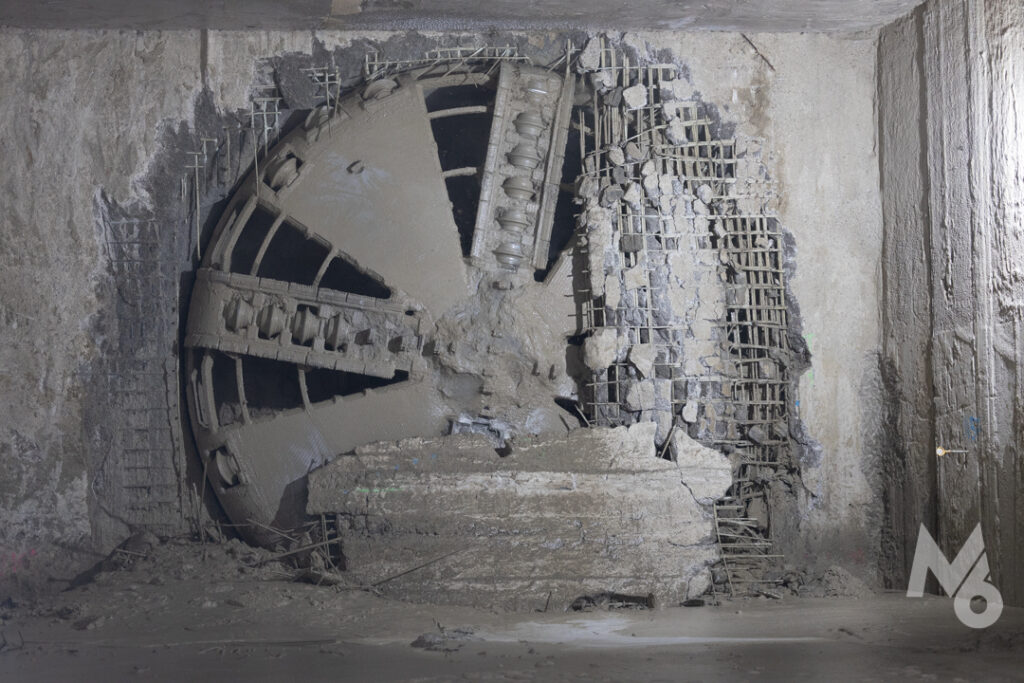
TBM “Sfânta Ana” broke through the wall of the future Piața Montreal metro station, today, on the alignment of the future M6 Metro Line.

The boring shield excavating the Line 1 tunnel on the SOUTH Section of M6 Metro Line has thereby completed the third tunnel segment on this line, running from the future Tokyo metro station towards 1 Mai station.

The double-track tunnel completed so far between the future Tokyo – Aeroport Băneasa – Gara Băneasa – Piața Montreal metro stations totals almost 3 km. On Line 1, TBM “Sfânta Ana” has excavated 2,838 linear metres and assembled 1,887 tunnel rings.

The length of the underground tunnel that TBM “Sfânta Ana” will complete as far as 1 Mai station is 6.6 km.

“We are content with the progress of works on M6 Metro Line. The breaking through of the wall at Piața Montreal station by TBM “Sfânta Ana” marks another important achievement in the construction of M6 Metro Line. The project is advancing at an efficient pace. M6 will provide a fast and modern connection between the metro network and Henri Coandă International Airport, contributing significantly to the development of urban mobility in Bucharest,” said Mariana MICLĂUȘ, Director General of Metrorex.

The “moles” digging the M6 metro: how a TBM builds the tunnel, ring by ring

The “moles” of M6 Metro Line dig the earth, bring it to the surface and build the tunnel behind them, almost simultaneously. Their technical name is TBM, from Tunnel Boring Machine.

The TBMs “Sfânta Maria” and “Sfânta Ana”, which are working on the SOUTH Section of M6 Metro Line, weigh around 600 tonnes and have cutterheads roughly 6.60 metres in diameter. In length, they come close to a football pitch. They enter the ground, and behind them they leave a circular, reinforced tunnel, ready for the next stages.

The front of the TBM carries the cutterhead, a huge metal disc fitted with cutting tools. It rotates, breaks up the ground and pushes the material into a chamber where the pressure is controlled at all times. The pressure keeps the excavation face stable and allows the machine to advance under control. From there, the material travels onto a screw conveyor, then onto conveyor belts, and out of the tunnel. It is loaded up and taken to authorised sites.

While digging goes on at the front, the tunnel is already being assembled behind the shield.

Segments and tunnel rings

The TBM advances using hydraulic rams that push against the last ring installed. After each advance, an erector lifts the segments, the precast concrete elements, and sets them side by side until a new ring is closed. A gap remains between the concrete ring and the ground, which is filled by injecting a special grout known as bentonite. The operation fixes the structure in place and helps stabilise the surrounding ground.

Then the cycle begins again: excavate, remove the material, advance the machine, install a ring, inject the grout. And so it goes, a few metres a day, month after month.

How the “mole” knows where to go

Tens of metres underground, orientation has nothing to do with instinct. The TBM has guidance systems, sensors and survey reference points tied to the project coordinates. The operators follow the alignment constantly and can correct the direction with very precise adjustments. From the control cabin they monitor, in real time, the pressure in the excavation chamber, the amount of material extracted and the position of the machine in relation to the designed axis. The operating parameters of the cutterhead and of the hydraulic systems, as well as the operations involved in fitting the rings are added to these are.

Under standard conditions, the TBMs on the SOUTH Section of M6 Metro Line in Bucharest advance at an average speed of approximately 1.5 metres per hour. It doesn’t seem like much, until you see what happens during that hour: the machine excavates around 60 cubic metres of material and prepares for the installation of the tunnel’s permanent structure.

An average of 13 to 14 rings are installed in 24 hours. The teams work in three shifts and the activity is continuous, with the breaks as required for checks and maintenance. The pace varies according to the ground, the recorded parameters and the maintenance work.

Romania’s “moles”: from the metro to tunnels through the mountains

TBM technology is not being used in Romania for the first time. On M5 Metro Line in Bucharest, the excavation was carried out by “Sfânta Varvara” and “Sfânta Filofteia”.

On the Brașov – Sighișoara railway line, on the Apața – Cața subsection, four TBMs are at work, “Eleni”, “Varvara”, “Alexandra” and “Konstantina”, on the Ormeniș and Homorod twin tunnels. The railway machines have a different diameter and work in different geological conditions, but the principle is the same: controlled excavation, removal of the material, immediate installation of the structure and monitoring of the parameters.

The names follow a long tradition in tunnelling projects. Saint Barbara is regarded as the protector of miners and of those who work underground. On M6 Metro Line, the tradition continues with “Sfânta Maria” and “Sfânta Ana”.

What happens at the surface

Although the activity takes place underground, the operation of the TBM is backed by an extensive monitoring system. The pressure in the excavation chamber, the amount of material extracted, the route of the machine and the soil characteristics are checked at all times. In the areas within the zone of influence of the works, special equipment is used to monitor the ground and the buildings.

The underground route to the airport

M6 Metro Line will have 14.2 kilometres of double track and 12 stations, and will create the first direct metro connection between Gara de Nord and Henri Coandă International Airport.

The video shows how the machine advances and how the concrete segments become, ring by ring, the structure of the future tunnel.

Press “Play” and step inside a TBM for a few minutes.

JICA monitoring mission on M6 Metro Line, an investment with government, European and Japanese funds

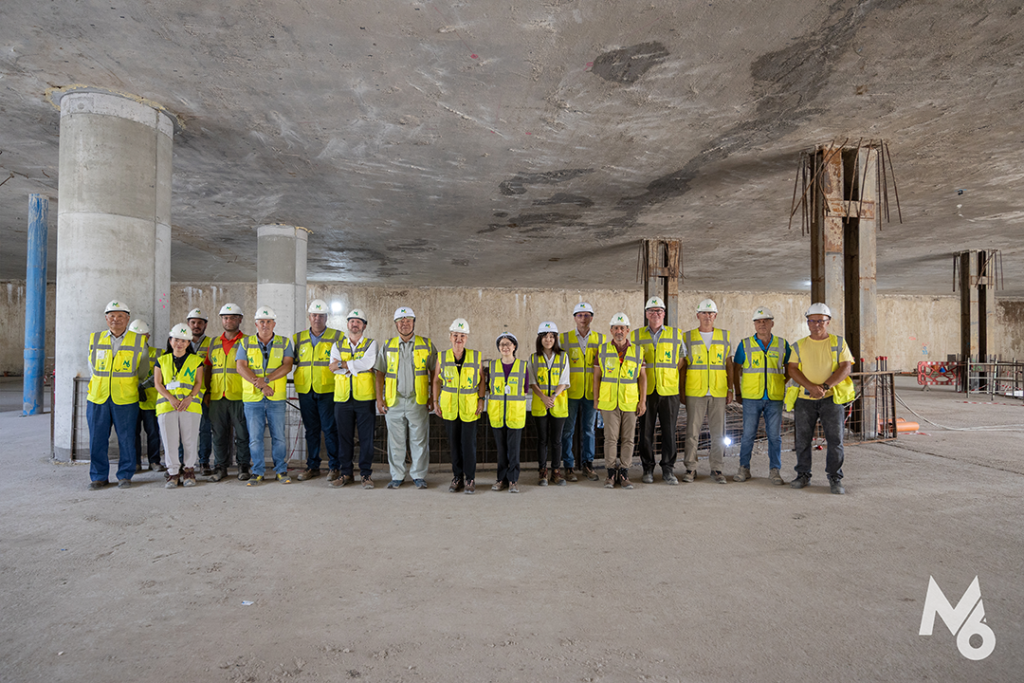
Between 17 and 19 August 2026, the Japan International Cooperation Agency (JICA) carried out a new mission in Bucharest to monitor the project co-financed through the ROM-P5 loan agreement for M6 Metro Line.


“Bucharest International Airport Rail Access Link Project (Metro Line 6. 1 Mai – Otopeni)” is a project of considerable local relevance, with a significant regional and international impact.

On behalf of JICA, one of the strategic funders of the M6 project, the delegation was led by Ms Hiroko Amano, Deputy Director within the Europe Division of the Department for the Middle East and Europe. During the visit, the JICA delegation held working meetings with representatives of the Ministry of Transport and Infrastructure, the Ministry of Finance, the Embassy of Japan in Romania, the supervisor, the contractors for Lot 1.1 and Lot 1.2, appointed for the design and build of the civil works, and the contractor for Package 2, appointed for the design and execution of the architectural works, railways, electromechanical and low-current installations.

The agenda of the mission included progress meetings to review the status of the project’s implementation and to secure the necessary budget allocations, as well as site visits. The Metrorex team, coordinated by Director General Mariana Miclăuș, presented the status of the works on the sites of the future M6 Metro Line. During these visits, the progress achieved and the next stages of the project were reviewed. In order to strengthen safety management in construction, the JICA mission paid particular attention to occupational safety, organising a seminar on the subject.

“Bucharest International Airport Rail Access Link Project (Metro Line 6. 1 Mai – Otopeni)” is a public utility project of national interest, in accordance with Government Decision no. 496/2017, as subsequently amended and supplemented, which addresses people’s mobility needs through the development of the trans-European transport network (TEN-T). The design and execution of the North Section of the new M6 Metro Line is financed from the state budget and from refundable external funds, through the external loan granted by JICA (Japan International Cooperation Agency).

The dialogue reconfirmed the importance of the strategic Romanian-Japanese partnership and the shared commitment to developing the BUCHAREST INTERNATIONAL AIRPORT RAIL ACCESS LINK PROJECT (METRO LINE 6. 1 MAI – OTOPENI) infrastructure project, a major investment landmark that is representative of the successful partnership between the two countries.

M6 Metro Line – for modern and sustainable public transport in Bucharest

On 7 July 2026, the United Nations held the first annual meeting to review the progress made under the “UN Decade of Sustainable Transport 2026–2035” – the UN Decade of Sustainable Transport Annual Stocktake.

The event, held as part of the High-Level Political Forum on Sustainable Development, highlighted the role of sustainable transport in accelerating the implementation of the Sustainable Development Goals. The discussions covered passenger and freight transport and their connections with economic development, sustainable infrastructure, jobs, sustainable energy, inclusive cities, climate action and health (details here: Official programme of the HLPF 2026 events – UN).

The UN Decade of Sustainable Transport was established by the UN General Assembly through Resolution A/RES/78/148, for the ten-year period that began on 1 January 2026. The initiative seeks to accelerate the development of safe, accessible, efficient, resilient and sustainable transport systems (further details here: UN General Assembly Resolution A/RES/78/148).

Sustainable transport means more than cutting emissions

The UN implementation plan for 2026–2035 shows that sustainable transport is not limited to protecting the environment. It must give people safe and predictable access to jobs, education, healthcare, markets and other opportunities.

Among the priority directions are the expansion of high-quality public transport, reducing dependence on cars, improving urban connectivity and developing accessible, safe, reliable and frequent services. According to the UN, investment in public transport can help reduce emissions and pollution, and can also improve access to opportunities for residents and for the business community.

M6 Metro Line – a European capital’s answer to the need for sustainable mobility

For Bucharest and its metropolitan area, these international objectives come to a concrete shape through the development of M6 Metro Line. The new line will have 14.2 kilometres of double track and 12 stations, connecting the capital’s metro network with residential, retail and business areas in the north of Bucharest, with the town of Otopeni and with Henri Coandă International Airport.

By extending high-capacity public transport along the Bucharest – Otopeni corridor, M6 Metro Line will offer an alternative to road travel. Shifting part of these journeys from the car to the metro can help reduce the pressure on traffic, local pollution and transport-related emissions.

The impact will also be social. The stations of the new line will bring public transport closer to the communities in the north of the capital and in Otopeni, making it easier to reach jobs, services, education, retail areas and airport infrastructure.

A local contribution to the Sustainable Development Goals

M6 Metro Line is relevant to several of the goals of the 2030 Agenda:

  • SDG 9 – Industry, innovation and infrastructure, through the development of modern public transport infrastructure;
  • SDG 11 – Sustainable cities and communities, through wider access to a high-capacity public transport system;
  • SDG 13 – Climate action, by creating the conditions for shifting journeys from individual road transport to public transport;
  • SDG 8 – Decent work and economic growth, through better access to business areas, jobs and airport infrastructure.

The project’s contribution to these goals does not come from building new infrastructure alone. It will also depend on the quality of the future service, on the accessibility of the stations, on integration with other modes of transport and, above all, on the number of people who choose the metro for their journeys.

M6 Metro Line is therefore an investment in the way Bucharest and its metropolitan area will develop in the future: better connected, more predictable and more sustainable.

15 June marks International Wind Energy Day / Global Wind Day, a moment dedicated to energy produced with the help of wind and to the role it can play in the transition towards a more sustainable energy system.

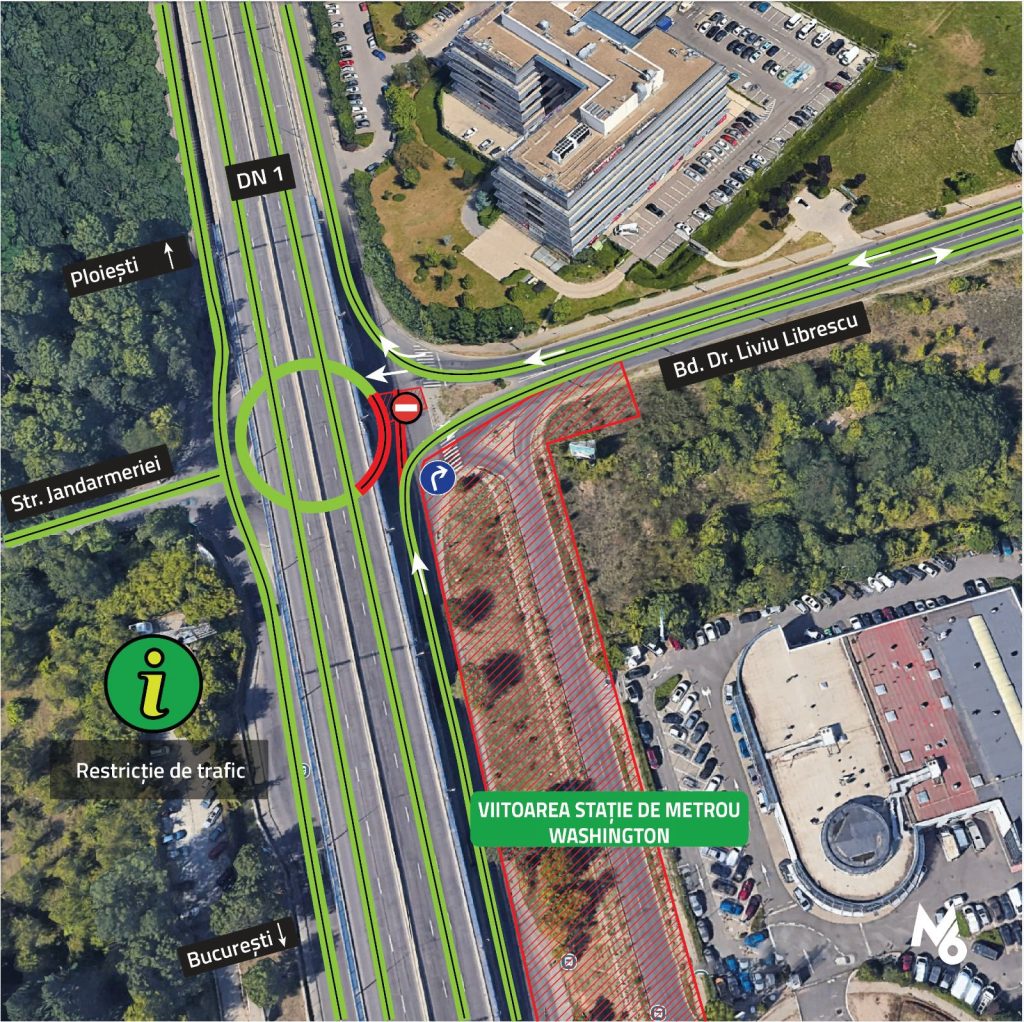
Temporary traffic restrictions in the area of the future Washington Station of M6 Metro Line

Starting on the night of 13/14 July 2026, a new stage of temporary traffic restrictions comes into force in the area of the junction between Șoseaua București – Ploiești (DN1) and Jandarmeriei Street, required for the utility relocation works for the future Washington Station of M6 Metro Line.

The following traffic restrictions will apply during this stage:
• the left turn from Jandarmeriei Street towards Otopeni is closed;
• straight-ahead movement on the Bucharest exit slip road of the Jandarmeriei overpass is closed.

The restrictions are imposed on the basis of the joint approval issued by C.N.A.I.R. and I.G.P.R., valid until 31 December 2026, with the possibility of an extension depending on how the works progress.

Traffic participants are asked to drive carefully, to observe the temporary road signs and to use the alternative routes indicated in the area.

We apologise for this inconvenience and thank all traffic participants for their understanding and cooperation.

Updated information on the progress of the works and on traffic restrictions will be published periodically on the official website of the project and on the communication channels of M6 Metro Line.

From university lecture halls to Romania’s major infrastructure projects

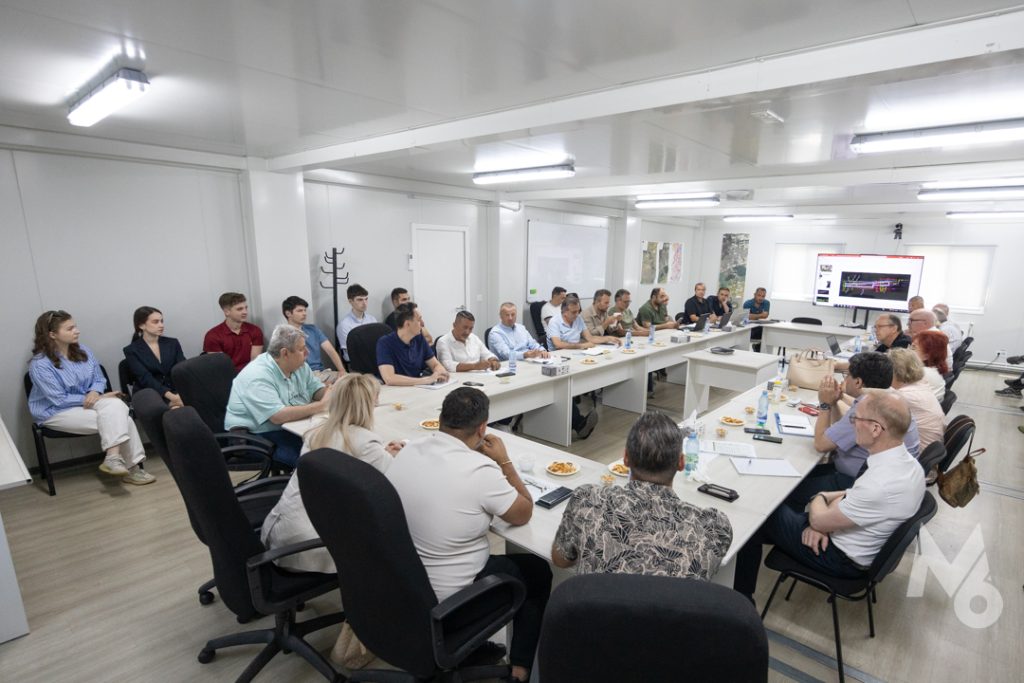
At the initiative of the Ministry of Transport and Infrastructure, in partnership with Metrorex, a group of future specialists took part in a progress meeting dedicated to the M6 Metro Line project, alongside representatives of the beneficiary, the contractors and the consultant supervisor.

The participants, whose educational background covers fields such as law, transport, public administration and business, had the opportunity to observe how the stages of a large-scale infrastructure project are coordinated, and to understand, directly from experienced professionals, the planning, collaboration and management processes required to implement a strategic investment.

The meeting provided a framework for dialogue between academic community and the specialists involved in implementing the project, highlighting the importance of practical experience in complementing theoretical knowledge and in training the next generation of infrastructure professionals.

Such initiatives help to strengthen the collaboration between public institutions and universities, giving young people the opportunity to understand the challenges and responsibilities involved in implementing complex projects that have a direct impact on the development of communities and on urban mobility.

Future engineers discover how tomorrow’s metro is built

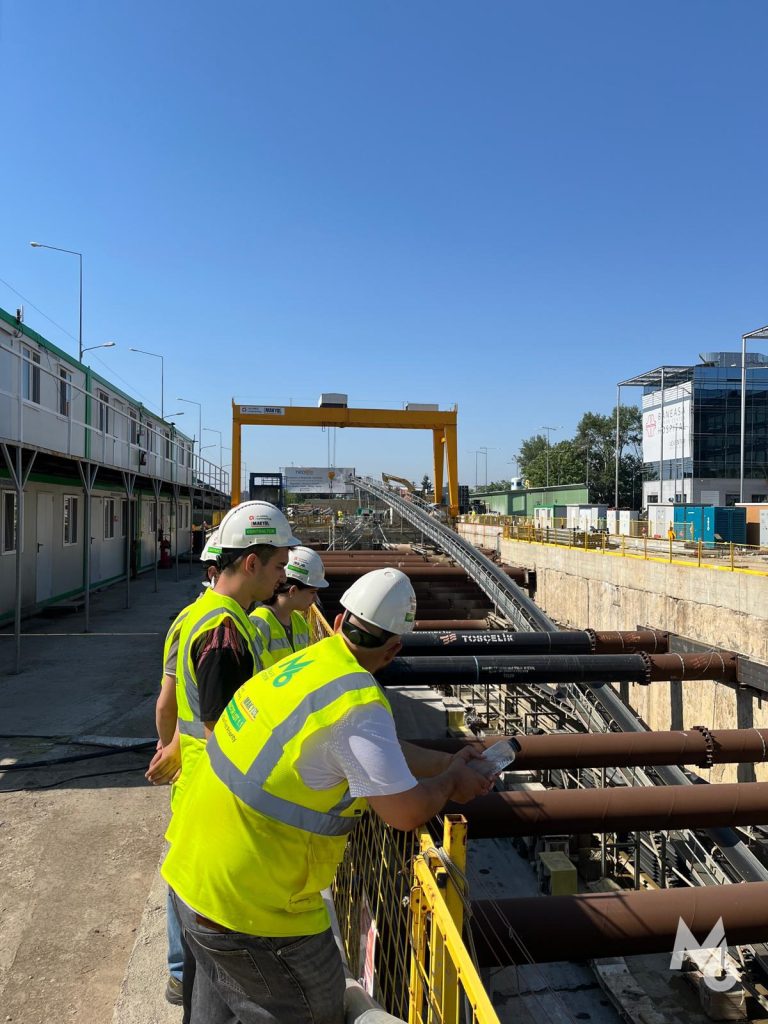
Third-year students from the Technical University of Civil Engineering Bucharest – Faculty of Railways, Roads and Bridges took part last week in a work training internship organised within the M6 Metro Line project, at the initiative of the Ministry of Transport and Infrastructure, in partnership with Metrorex.

During the programme, the future engineers had the opportunity to understand how a complex metro infrastructure project is implemented, through meetings with the contractor’s specialists in fields such as design, topography, surveying, planning, quality management and occupational safety. The activities gave them a practical perspective on the stages and responsibilities involved in building a metro line.

The programme also included technical presentations on the construction processes and on the use of the TBMs “Sfânta Maria” and “Sfânta Ana”, which are excavating the tunnels of M6 Metro Line. Through direct contact with the professionals involved in the project, the students had the chance to understand the challenges and the technologies specific to building metro transport infrastructure.

Initiatives of this kind help train future specialists and strengthen the collaboration between academic environment, the public authorities and the construction sector, giving students a concrete picture of the profession they are to embrace.

In the coming period, extreme temperatures and weather conditions will require special measures to be taken for work on construction sites, whether due to a heatwave or instability of the weather. For this reason, visits and other activities that involve access to the working area by people outside the construction teams will be temporarily suspended and will resume when conditions allow them to take place in complete safety.

M6 Metro Line will create the first direct metro link between Gara de Nord and Henri Coandă International Airport. The new line will have 14.2 km of double track and 12 stations, contributing to the development of urban mobility and to the integration of rail, road and air transport.

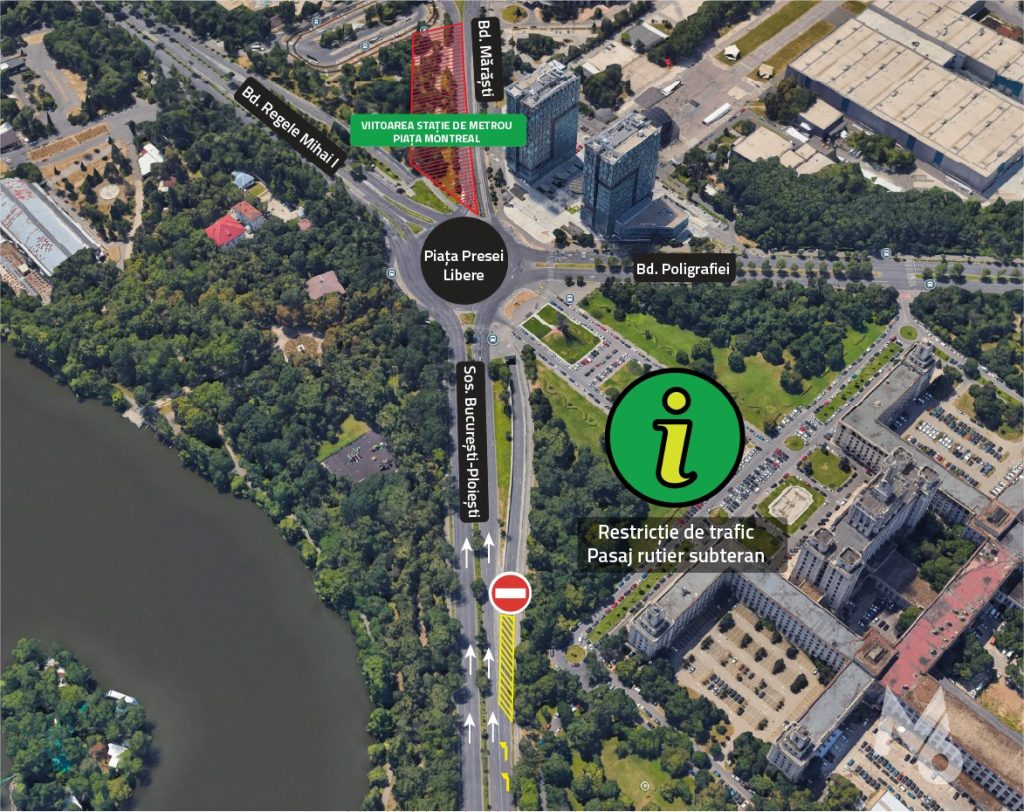
Temporary traffic restriction in the Piața Presei Libere underpass, on the night of 2/3 July

On the night of 2/3 July 2026, between 23:00 and 04:00, access to the Piața Presei Libere underpass will be temporarily restricted so that remedial works can be carried out.


The restriction is necessary to repair damage affecting the power supply cable of the topographic total stations installed in the underpass, in the area of the future Piața Montreal metro station, on the SOUTH Section of Metro Line 6. The fault was caused by the storm that hit Bucharest on the night of 30 June/1 July 2026. The damage was caused by the storm that hit Bucharest on the night of 30 June/1 July 2026.


Except for the period mentioned, traffic through the underpass will run normally. Traffic on the carriageway outside the underpass will neither be restricted nor diverted.


We apologise for this inconvenience and thank all traffic participants for their understanding.
We invite you to continue following the website www.magistrala6.ro and the official communication channels of the project for updated information on the progress of the works and on any traffic restrictions.

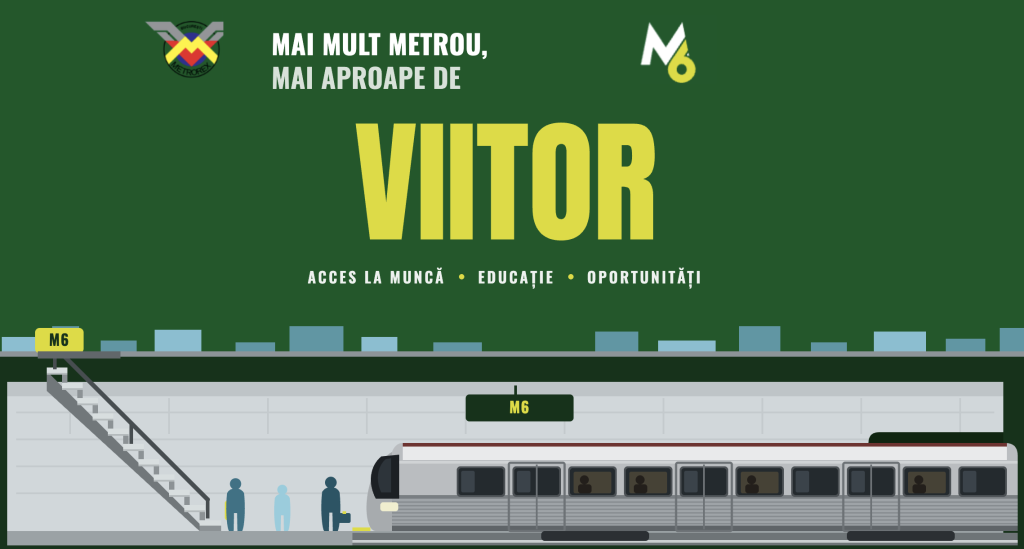
Closer to the city, closer to the future: how M6 Metro Line brings people nearer to their opportunities

For a family in Otopeni or in the north of Ilfov county, the journey to Bucharest is not just a few kilometres on a map. It means mornings spent in traffic, time lost on the road, less hours with the family and, sometimes, opportunities that are harder to access.

That is why sustainability is not just about cleaner air, lower emissions or more efficient technical solutions. It means easier access to work, to school, to services and to the places where everyone builds their future.

Seen in that light, M6 Metro Line is more than just a metro line. It is a new connection between communities and the city, between home and workplace, between school and family, between the present and tomorrow’s opportunities.

Commuting is not just lost time

The daily journey to work or to school has a greater impact than it might seem at first sight. A study carried out by researchers Raj Chetty and Nathaniel Hendren at Harvard University, based on data from around 40 million people, has shown that commuting time is one of the most important factors associated with the chances of social mobility. The conclusion is that when people have access to reliable, predictable and affordable transport, they are more likely to secure better jobs, access education and essential services.

The same idea is also supported by mobility experts. The International Transport Forum, part of the OECD family, emphasises that the role of transport is to bring education, healthcare, jobs and everyday activities closer to people.

Quality transport does more than simply move people from one place to another. It gives them greater freedom of choice. It makes everyday life easier. It opens up routes that might otherwise seem too long or too difficult to travel.

A young community, growing fast

The area around M6 Metro Line is one of the most dynamic in Romania. Between the 2011 and 2021 censuses, Ilfov County recorded one of the highest population growth rates in the European Union, at around 40%. At the same time, Ilfov is the youngest county in Romania, with an average age of 38.6 years.

Behind these figures are people: young families, children, parents who work in Bucharest, pupils and students who commute every day, growing communities that need better connections with the city.

However, this development also brings challenges. More and more people are travelling between Ilfov and Bucharest every day, and the roads are becoming increasingly congested. For a pupil attending secondary school in the capital, for a student, or for a parent who works in the city, every hour spent in traffic is an hour taken away from their personal time, their leisure time, and their family life.

How M6 is making a difference to the community

This is where M6 Metro Line comes in. On the North Section, Lot 1.2 Tokyo – Aeroport Otopeni, the new metro line will connect the northern area of the capital and the town of Otopeni with the Bucharest metro network and with Henri Coandă International Airport.

Stations such as Bruxelles, Otopeni, Ion I.C. Brătianu and Aeroport Otopeni will bring high-capacity public transport closer to the communities that need it daily.

For the people living near the metro line, this means greater predictability. A teenager will be able to reach secondary school or university more easily. A parent will be able to get to work without depending constantly on the car or on road traffic. A family with a single car, or with no car at all, will have more options.

It also means more equitable access to opportunities. Because when public transport becomes more accessible and efficient, opportunities no longer depend so much on distance, traffic or whether or not one owns a car.

More than transport

The benefits of a metro line do not stop at the time saved on the journey. Modern transport infrastructure can support the development of the areas around the stations, encourage new services to appear, attract investments and connect the communities better.

Over time, the areas around the stations can become livelier, more accessible and better integrated into city life. Places where people do not just pass through, but live, work, learn and make plans.

A metro that brings people closer

M6 Metro Line is not just an investment in infrastructure. It is an investment in saved time, in easier access, in mobility and in better chances for the community.

Through this new link with Bucharest and with Henri Coandă International Airport, people in the northern area of the capital and in Otopeni will be closer to the places where they work, study and build their future.

Today we are building the infrastructure that will bring tomorrow communities closer to their opportunities. Because a sustainable city is, above all, a city in which people can reach one another more easily.