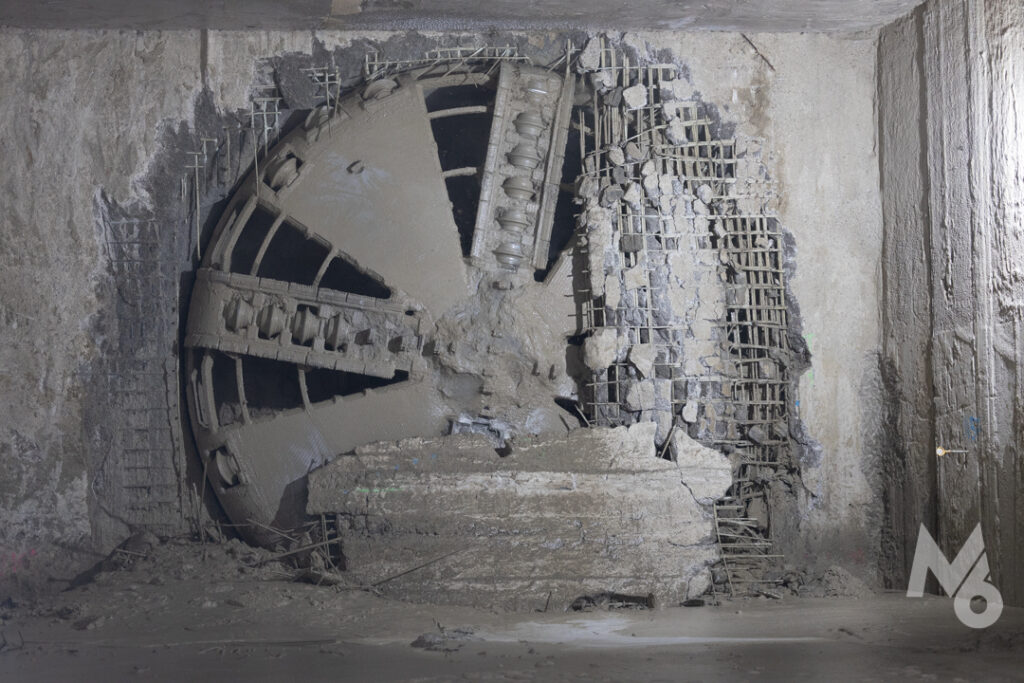
TBM “Sfânta Ana” broke through the wall of the future Piața Montreal metro station, today, on the alignment of the future M6 Metro Line.
The boring shield excavating the Line 1 tunnel on the SOUTH Section of M6 Metro Line has thereby completed the third tunnel segment on this line, running from the future Tokyo metro station towards 1 Mai station.
The double-track tunnel completed so far between the future Tokyo – Aeroport Băneasa – Gara Băneasa – Piața Montreal metro stations totals almost 3 km. On Line 1, TBM “Sfânta Ana” has excavated 2,838 linear metres and assembled 1,887 tunnel rings.
The length of the underground tunnel that TBM “Sfânta Ana” will complete as far as 1 Mai station is 6.6 km.
“We are content with the progress of works on M6 Metro Line. The breaking through of the wall at Piața Montreal station by TBM “Sfânta Ana” marks another important achievement in the construction of M6 Metro Line. The project is advancing at an efficient pace. M6 will provide a fast and modern connection between the metro network and Henri Coandă International Airport, contributing significantly to the development of urban mobility in Bucharest,” said Mariana MICLĂUȘ, Director General of Metrorex.
The “moles” of M6 Metro Line dig the earth, bring it to the surface and build the tunnel behind them, almost simultaneously. Their technical name is TBM, from Tunnel Boring Machine.
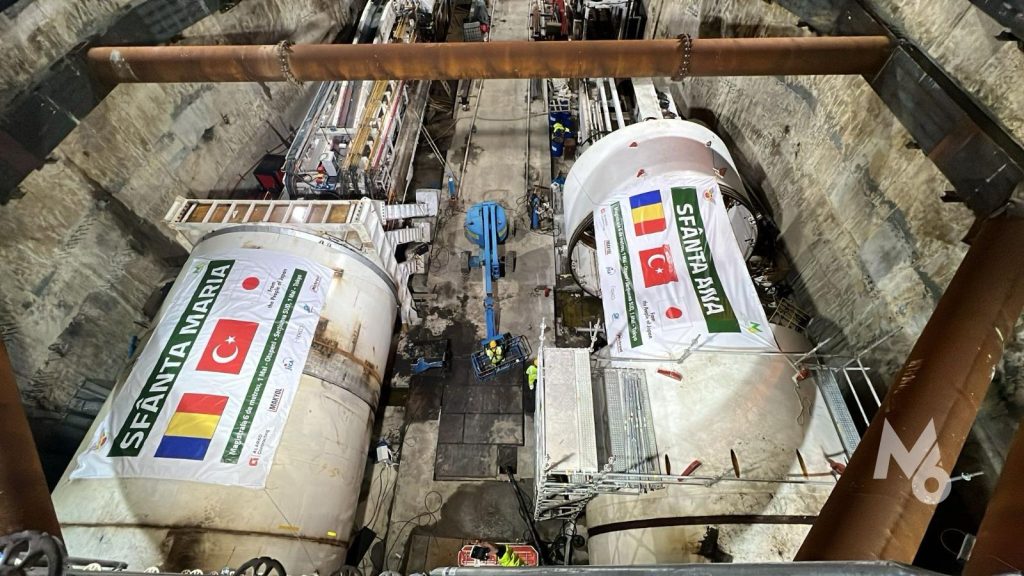
The TBMs “Sfânta Maria” and “Sfânta Ana”, which are working on the SOUTH Section of M6 Metro Line, weigh around 600 tonnes and have cutterheads roughly 6.60 metres in diameter. In length, they come close to a football pitch. They enter the ground, and behind them they leave a circular, reinforced tunnel, ready for the next stages.
The front of the TBM carries the cutterhead, a huge metal disc fitted with cutting tools. It rotates, breaks up the ground and pushes the material into a chamber where the pressure is controlled at all times. The pressure keeps the excavation face stable and allows the machine to advance under control. From there, the material travels onto a screw conveyor, then onto conveyor belts, and out of the tunnel. It is loaded up and taken to authorised sites.
While digging goes on at the front, the tunnel is already being assembled behind the shield.
Segments and tunnel rings
The TBM advances using hydraulic rams that push against the last ring installed. After each advance, an erector lifts the segments, the precast concrete elements, and sets them side by side until a new ring is closed. A gap remains between the concrete ring and the ground, which is filled by injecting a special grout known as bentonite. The operation fixes the structure in place and helps stabilise the surrounding ground.
Then the cycle begins again: excavate, remove the material, advance the machine, install a ring, inject the grout. And so it goes, a few metres a day, month after month.
How the “mole” knows where to go
Tens of metres underground, orientation has nothing to do with instinct. The TBM has guidance systems, sensors and survey reference points tied to the project coordinates. The operators follow the alignment constantly and can correct the direction with very precise adjustments. From the control cabin they monitor, in real time, the pressure in the excavation chamber, the amount of material extracted and the position of the machine in relation to the designed axis. The operating parameters of the cutterhead and of the hydraulic systems, as well as the operations involved in fitting the rings are added to these are.
Under standard conditions, the TBMs on the SOUTH Section of M6 Metro Line in Bucharest advance at an average speed of approximately 1.5 metres per hour. It doesn’t seem like much, until you see what happens during that hour: the machine excavates around 60 cubic metres of material and prepares for the installation of the tunnel’s permanent structure.
An average of 13 to 14 rings are installed in 24 hours. The teams work in three shifts and the activity is continuous, with the breaks as required for checks and maintenance. The pace varies according to the ground, the recorded parameters and the maintenance work.
Romania’s “moles”: from the metro to tunnels through the mountains
TBM technology is not being used in Romania for the first time. On M5 Metro Line in Bucharest, the excavation was carried out by “Sfânta Varvara” and “Sfânta Filofteia”.
On the Brașov – Sighișoara railway line, on the Apața – Cața subsection, four TBMs are at work, “Eleni”, “Varvara”, “Alexandra” and “Konstantina”, on the Ormeniș and Homorod twin tunnels. The railway machines have a different diameter and work in different geological conditions, but the principle is the same: controlled excavation, removal of the material, immediate installation of the structure and monitoring of the parameters.
The names follow a long tradition in tunnelling projects. Saint Barbara is regarded as the protector of miners and of those who work underground. On M6 Metro Line, the tradition continues with “Sfânta Maria” and “Sfânta Ana”.
What happens at the surface
Although the activity takes place underground, the operation of the TBM is backed by an extensive monitoring system. The pressure in the excavation chamber, the amount of material extracted, the route of the machine and the soil characteristics are checked at all times. In the areas within the zone of influence of the works, special equipment is used to monitor the ground and the buildings.
The underground route to the airport
M6 Metro Line will have 14.2 kilometres of double track and 12 stations, and will create the first direct metro connection between Gara de Nord and Henri Coandă International Airport.
The video shows how the machine advances and how the concrete segments become, ring by ring, the structure of the future tunnel.
Press “Play” and step inside a TBM for a few minutes.
The Tunnel Boring Machine (TBM) “Sfânta Maria” broke through the wall of the future Piața Montreal metro station, today, on the alignment of the future M6 Metro Line.
Representatives of the Ministry of Transport and Infrastructure and of Metrorex attended the event.
The boring shield “Sfânta Maria” is excavating the Line 2 tunnel on the SOUTH Section of M6 Metro Line, and today it completed the third tunnel segment on this line.
The tunnel completed so far by the machine – 97 metres long, weighing 600 tonnes, with a cutterhead 6.60 metres in diameter – between the future Tokyo, Aeroport Băneasa, Gara Băneasa and Piața Montreal metro stations, totals almost 3 km (2,836 linear metres) excavated and 1,895 tunnel rings assembled.
The length of the underground tunnel that TBM “Sfânta Maria” will complete to 1 Mai station is 6.6 km.
“Metrorex continues to build for people, for the city, for Romania and for a sustainable future. The breaking through of the wall of Piața Montreal station by TBM “Sfânta Maria” is another important milestone in the construction of M6 Metro Line. The pace at which the works are advancing is the result of the good coordination between everyone involved in the project, from the contractors to the funders. M6 Metro Line will provide a fast and modern connection between the metro network and Henri Coandă International Airport, contributing significantly to the development of urban mobility in Bucharest,” said the Director General of Metrorex, who attended the event.
March has begun on the SOUTH Section with the completion of the second tunnel segment, roughly 2 km long, between the future Tokyo, Aeroport Băneasa and Gara Băneasa metro stations, on Line 1.
TBM “Sfânta Ana” has excavated 2,006 metres and installed 1,334 tunnel rings, making a decisive contribution to the progress of the works. With high-performance TBMs and sustained effort, we are building a new metro line for Bucharest, step by step.
The length of the metro tunnel that TBM “Sfânta Ana” will complete up to 1 Mai station is 6.6 km.
The ‘Sfânta Maria’ TBM broke through the wall of the future Gara Băneasa metro station today, on the route of the future M6 Metro Line.
The boring shield “Sfânta Maria” is excavating the Line 2 tunnel on the SOUTH Section of M6 Metro Line, and today marks the completion of the second tunnel segment on this line.
The tunnel completed so far by the giant machine (TBM “Sfânta Maria” is 97 metres long, weighs 600 tonnes and has a cutterhead 6.60 metres in diameter), between the future Tokyo, Aeroport Băneasa and Gara Băneasa metro stations, totals 2,006 metres excavated and 1,334 tunnel rings assembled.
The length of the underground tunnel that TBM “Sfânta Maria” will complete up to 1 Mai station is 6.6 km.
“We are starting 2026 by marking yet another significant milestone in the construction of M6 Metro Line! The progress of both tunnel boring machines – the ‘Sfânta Maria’ TBM and the ‘Sfânta Ana’ TBM – is in line with the construction schedule for building the civil works for the SOUTH Section of the future M6 Metro Line! The “Sfânta Maria” machine has arrived safely at Gara Băneasa, whilst the “Sfânta Ana” tunnel boring machine is also heading towards this destination, having already covered over 1,600 metres and assembled 1,076 tunnel rings” said Mariana Miclăuș, Director General of Metrorex.
Metrorex continues to build for people, for the city, for Romania and for a sustainable future.
Today, the “Sfânta Ana” boring shield has broke through the wall of the future Aeroport Băneasa metro station on M6 Metro Line.
The giant machine began excavating the tunnel on Line 1 on May 28, 2025, from the future Tokyo metro station.
This event marks the completion of the first double-sided tunnel segment on the SOUTH Section of the future M6 Metro Line, with Line 2 having been finished over the same distance by the “Sfânta Maria” TBM in the middle of the previous month.
The segment completed by the “Sfânta Ana” boring machine amounts 900 linear meters excavated and 600 tunnel rings assembled!
We are glad that the two boring machines are keeping pace with the schedule for completing the structural civil works for the SOUTH Section of the future M6 Metro Line!
The TBMs “Sfânta Maria” and “Sfânta Ana” will excavate the 6.6 km long underground tunnels, on which the six stations and six interstations of the alignment of M6 Metro Line, SOUTH Section, 1 Mai – Tokyo, will be built.
Metrorex continues to build for people, for the city, for Romania, and for a sustainable future!
Today, the “Sfânta Maria” TBM broke through the wall of the future Aeroport Băneasa metro station, crowning the joy of the recent celebration on August 15.
Excavation of the tunnel on Line 2 has began on April 9, 2025, at the future Tokyo metro station, and during this period the first tunnel segment on the SOUTH Section of the future M6 Metro Line has been completed.
In figures, this segment represents 902 linear meters excavated and 602 tunnel rings assembled!
Meanwhile, the “Sfânta Ana” TBM is executing the first tunnel segment on Line 1 of the SOUTH Section. At this point, it has excavated over 406 linear meters and assembled over 265 tunnel rings.
The TBMs “Sfânta Maria” and “Sfânta Ana” will excavate the 6.6 km long underground tunnels, on which the six stations and six interstations of the M6 Metro Line alignment, SOUTH Section, 1 Mai – Tokyo, will be built.
Metrorex continues to build for people, for the city, for Romania, and for a sustainable future!
The second operational TBM machine on the South Section of M6 Metro Line goes into action.It also runs from the future Tokyo metro station to 1 Mai, excavating the second tunnel on the SOUTH Section.
Being named “Sfânta Ana”, an emblematic spiritual symbol, the TBM that will dig the twin tunnel that the TBM “Sfânta Maria” is drilling, is 105 meters long, weighs about 600 tons, and its cutter head is about 6.60 meters in diameter.
The TBM’s average forward speed is 1.5m per hour, excavating about 60 cubic meters of soil. As it excavates and removes the excavated soil, the TBM mounts the tunnel rings. The tunnel rings are transported by MSV (Multi Service Vehicle), a special transport vehicle that can carry up to 50 tons. The average fitting is 13 to 14 rings per tunnel in 24 hours. The staff operating the TBM work 24 hours a day in three shifts. Except for necessary maintenance breaks, the TBM runs continuously.
We wish the TBM “Sfânta Ana” a smooth and efficient journey through the underground!
The first operational TBM on the SOUTH Section of M6 Metro Line is ready for start. During a launching ceremony attended by officials, Metrorex representatives, JICA representatives, representatives of the Contractor appointed for the execution of the contract “Bucharest International Airport Rail Access Link Project (Metro Line 6. 1 Mai-Otopeni). Design and Build – Civil Works for Lot 1.1: 1 Mai-Tokyo”, and representatives of the Consultant Supervisor, the cutter head of the giant machine makes today its first rotation marking the start of drilling activities from the future metro station Tokyo to the existing metro station 1 Mai.
Usually, the TBM machines are named with names of saints. The TBM to start at today’s launch ceremony to mark this momentous occasion is called ‘Sfânta Maria’ – the symbol of divine protection and care for all humanity. Next to it will be active the second shield, named “Sfânta Ana”, another iconic figure of Orthodox spirituality, representing wisdom, patience and steadfast faith. The machine bearing the name “Sfânta Maria” was brought to Romania close to September 8, the feast of the Nativity of the Virgin Mary. The second TBM is called “Sfânta Ana”, as the holidays follow one another in the calendar. The two machines will excavate the 6.6 km-long underground tunnels through which will be built the six stations and six interstations on the alignment of the M6 Metro Line, Section SUD, 1 Mai – Tokyo.
„This day marks a new milestone in the accomplishment of M6 Metro Line, a major urban infrastructure project that will significantly improve public transport, people’s mobility, road traffic and people’s lives. It is an important day for Bucharest and for the extension of the metro network. With financing from the state budget, European funds and JICA reimbursable external funds, Metrorex S.A. is among those who are building for the people, for Romania, for a sustainable future”, says Mariana Miclăuș, General Manager of Metrorex.
The “Sfânta Maria” TBM is 97 meters long, weighs about 600 tons and has a 6.60-meter drill head. The TBM’s average forward speed is 1.5 meters per hour, during which it excavates about 60 cubic meters of earth. As it excavates and removes the excavated soil, the TBM mounts the tunnel rings. The tunnel rings are transported by MSV (Multi Service Vehicle), a special transport vehicle that can carry up to 50 tons. The average installation rate is 13 to 14 rings per tunnel in 24 hours and the staff operating the TBM work 24 hours in three shifts. Except for necessary breaks for maintenance, the TBM runs continuously.
In the period following the start of operation of the “Sfânta Maria” TBM, the “Sfânta Ana” TBM will also become operational. It will also start from the future Tokyo metro station towards 1 Mai, excavating the second tunnel on the SOUTH Section.
On the SOUTH SECTION of the future M6 Metro Line, 1 Mai – Tokyo, work continues at a fast pace in the area of the station and launch shaft of the future Tokyo metro station.
Mărțișorul este mai mult decât un simplu simbol al primăverii – este o tradiție cu rădăcini adânci în cultura românească, o punte între trecut și viitor, între natură și om.
📜 Origini și Evoluție
🔍 Cercetările arheologice atestă existența mărțișorului de peste 8.000 de ani, fiind asociat cu obiceiurile dacice și romane. În trecut, oamenii purtau amulete din pietricele vopsite în alb și roșu, legate cu un fir împletit, pentru noroc și protecție.
🏛 În Roma Antică, 1 martie marca începutul primăverii și al noului an, sub patronajul lui Marte, zeul războiului, dar și al fertilității și regenerării naturii.
🎨 Semnificația Culorilor
🔴 Roșu – simbolizează viața, pasiunea și energia. ⚪ Alb – reprezintă puritatea, echilibrul și înțelepciunea.
Împreună, cele două culori reflectă lupta contrariilor – iarna și primăvara, întunericul și lumina, trecutul și viitorul.
🌿 Tradiții și Obiceiuri
Mărțișorul a fost purtat dintotdeauna ca un talisman aducător de noroc, sănătate și prosperitate. După o anumită perioadă, acesta era: 🌳 Legat de crengile unui copac înflorit – pentru a aduce belșug și fertilitate. 💦 Aruncat în râu – într-un ritual ce marca începutul unui nou ciclu al vieții.