From university lecture halls to Romania’s major infrastructure projects

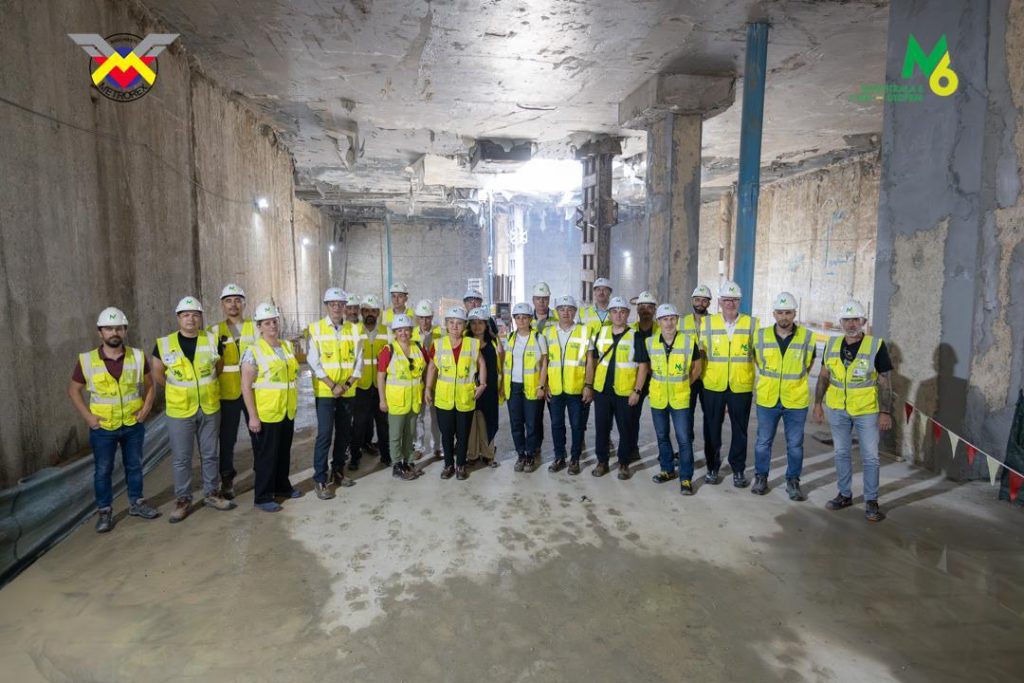
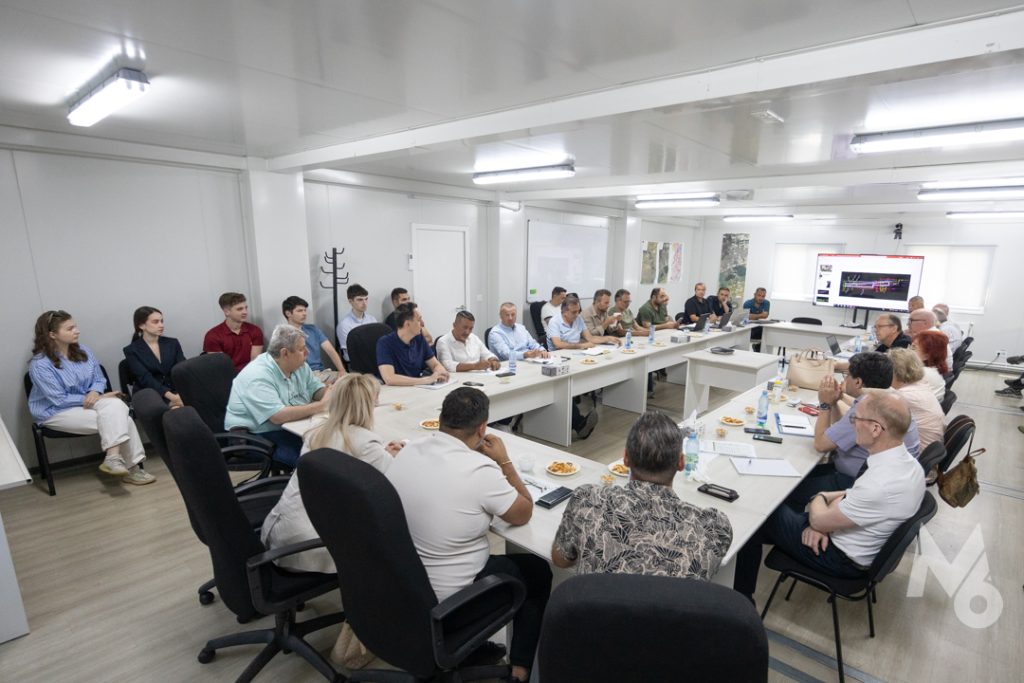
At the initiative of the Ministry of Transport and Infrastructure, in partnership with Metrorex, a group of future specialists took part in a progress meeting dedicated to the M6 Metro Line project, alongside representatives of the beneficiary, the contractors and the consultant supervisor.

The participants, whose educational background covers fields such as law, transport, public administration and business, had the opportunity to observe how the stages of a large-scale infrastructure project are coordinated, and to understand, directly from experienced professionals, the planning, collaboration and management processes required to implement a strategic investment.

The meeting provided a framework for dialogue between academic community and the specialists involved in implementing the project, highlighting the importance of practical experience in complementing theoretical knowledge and in training the next generation of infrastructure professionals.

Such initiatives help to strengthen the collaboration between public institutions and universities, giving young people the opportunity to understand the challenges and responsibilities involved in implementing complex projects that have a direct impact on the development of communities and on urban mobility.

Future engineers discover how tomorrow’s metro is built

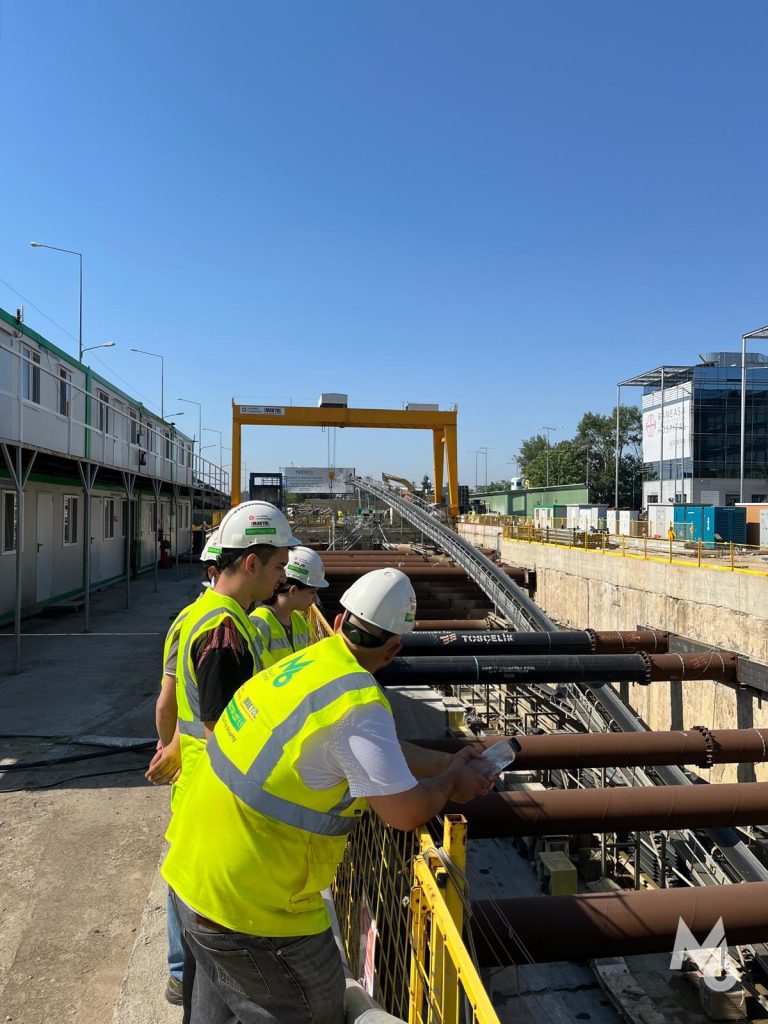
Third-year students from the Technical University of Civil Engineering Bucharest – Faculty of Railways, Roads and Bridges took part last week in a work training internship organised within the M6 Metro Line project, at the initiative of the Ministry of Transport and Infrastructure, in partnership with Metrorex.

During the programme, the future engineers had the opportunity to understand how a complex metro infrastructure project is implemented, through meetings with the contractor’s specialists in fields such as design, topography, surveying, planning, quality management and occupational safety. The activities gave them a practical perspective on the stages and responsibilities involved in building a metro line.

The programme also included technical presentations on the construction processes and on the use of the TBMs “Sfânta Maria” and “Sfânta Ana”, which are excavating the tunnels of M6 Metro Line. Through direct contact with the professionals involved in the project, the students had the chance to understand the challenges and the technologies specific to building metro transport infrastructure.

Initiatives of this kind help train future specialists and strengthen the collaboration between academic environment, the public authorities and the construction sector, giving students a concrete picture of the profession they are to embrace.

In the coming period, extreme temperatures and weather conditions will require special measures to be taken for work on construction sites, whether due to a heatwave or instability of the weather. For this reason, visits and other activities that involve access to the working area by people outside the construction teams will be temporarily suspended and will resume when conditions allow them to take place in complete safety.

M6 Metro Line will create the first direct metro link between Gara de Nord and Henri Coandă International Airport. The new line will have 14.2 km of double track and 12 stations, contributing to the development of urban mobility and to the integration of rail, road and air transport.

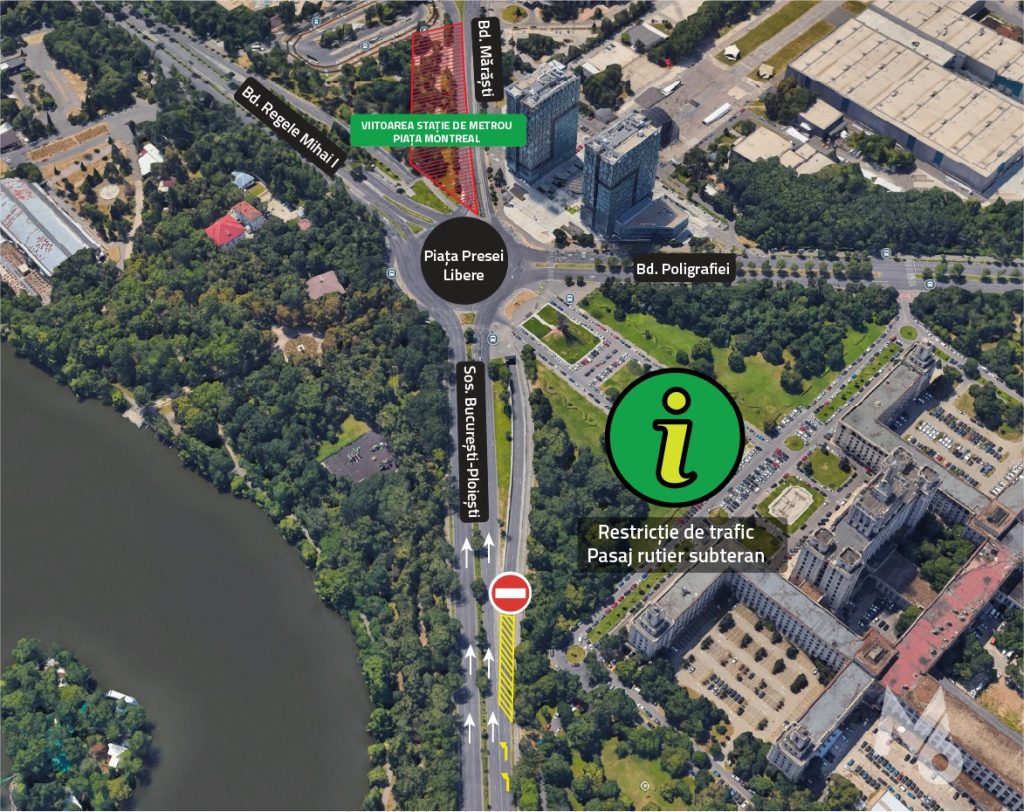
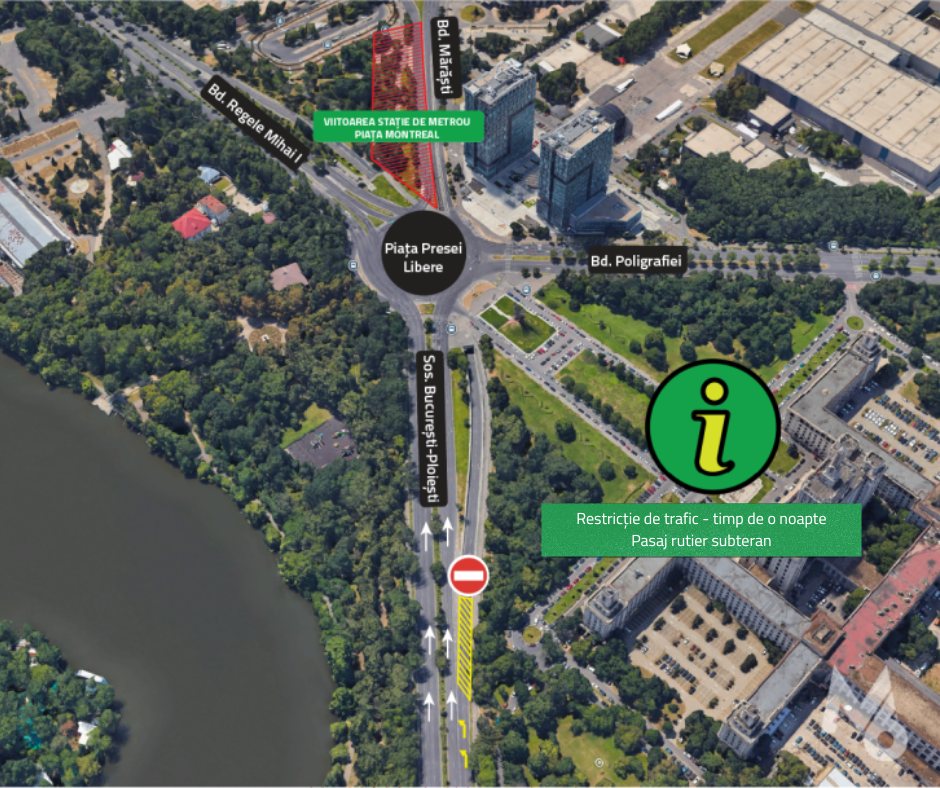
Temporary traffic restriction in the Piața Presei Libere underpass, on the night of 2/3 July

On the night of 2/3 July 2026, between 23:00 and 04:00, access to the Piața Presei Libere underpass will be temporarily restricted so that remedial works can be carried out.


The restriction is necessary to repair damage affecting the power supply cable of the topographic total stations installed in the underpass, in the area of the future Piața Montreal metro station, on the SOUTH Section of M6 Metro Line. The fault was caused by the storm that hit Bucharest on the night of 30 June/1 July 2026. The damage was caused by the storm that hit Bucharest on the night of 30 June/1 July 2026.


Except for the period mentioned, traffic through the underpass will run normally. Traffic on the carriageway outside the underpass will neither be restricted nor diverted.


We apologise for this inconvenience and thank all traffic participants for their understanding.
We invite you to continue following the website www.magistrala6.ro and the official communication channels of the project for updated information on the progress of the works and on any traffic restrictions.

Closer to the city, closer to the future: how M6 Metro Line brings people nearer to their opportunities

For a family in Otopeni or in the north of Ilfov county, the journey to Bucharest is not just a few kilometres on a map. It means mornings spent in traffic, time lost on the road, less hours with the family and, sometimes, opportunities that are harder to access.

That is why sustainability is not just about cleaner air, lower emissions or more efficient technical solutions. It means easier access to work, to school, to services and to the places where everyone builds their future.

Seen in that light, M6 Metro Line is more than just a metro line. It is a new connection between communities and the city, between home and workplace, between school and family, between the present and tomorrow’s opportunities.

Commuting is not just lost time

The daily journey to work or to school has a greater impact than it might seem at first sight. A study carried out by researchers Raj Chetty and Nathaniel Hendren at Harvard University, based on data from around 40 million people, has shown that commuting time is one of the most important factors associated with the chances of social mobility. The conclusion is that when people have access to reliable, predictable and affordable transport, they are more likely to secure better jobs, access education and essential services.

The same idea is also supported by mobility experts. The International Transport Forum, part of the OECD family, emphasises that the role of transport is to bring education, healthcare, jobs and everyday activities closer to people.

Quality transport does more than simply move people from one place to another. It gives them greater freedom of choice. It makes everyday life easier. It opens up routes that might otherwise seem too long or too difficult to travel.

A young community, growing fast

The area around M6 Metro Line is one of the most dynamic in Romania. Between the 2011 and 2021 censuses, Ilfov County recorded one of the highest population growth rates in the European Union, at around 40%. At the same time, Ilfov is the youngest county in Romania, with an average age of 38.6 years.

Behind these figures are people: young families, children, parents who work in Bucharest, pupils and students who commute every day, growing communities that need better connections with the city.

However, this development also brings challenges. More and more people are travelling between Ilfov and Bucharest every day, and the roads are becoming increasingly congested. For a pupil attending secondary school in the capital, for a student, or for a parent who works in the city, every hour spent in traffic is an hour taken away from their personal time, their leisure time, and their family life.

How M6 is making a difference to the community

This is where M6 Metro Line comes in. On the North Section, Lot 1.2 Tokyo – Aeroport Otopeni, the new metro line will connect the northern area of the capital and the town of Otopeni with the Bucharest metro network and with Henri Coandă International Airport.

Stations such as Bruxelles, Otopeni, Ion I.C. Brătianu and Aeroport Otopeni will bring high-capacity public transport closer to the communities that need it daily.

For the people living near the metro line, this means greater predictability. A teenager will be able to reach secondary school or university more easily. A parent will be able to get to work without depending constantly on the car or on road traffic. A family with a single car, or with no car at all, will have more options.

It also means more equitable access to opportunities. Because when public transport becomes more accessible and efficient, opportunities no longer depend so much on distance, traffic or whether or not one owns a car.

More than transport

The benefits of a metro line do not stop at the time saved on the journey. Modern transport infrastructure can support the development of the areas around the stations, encourage new services to appear, attract investments and connect the communities better.

Over time, the areas around the stations can become livelier, more accessible and better integrated into city life. Places where people do not just pass through, but live, work, learn and make plans.

A metro that brings people closer

M6 Metro Line is not just an investment in infrastructure. It is an investment in saved time, in easier access, in mobility and in better chances for the community.

Through this new link with Bucharest and with Henri Coandă International Airport, people in the northern area of the capital and in Otopeni will be closer to the places where they work, study and build their future.

Today we are building the infrastructure that will bring tomorrow communities closer to their opportunities. Because a sustainable city is, above all, a city in which people can reach one another more easily.

A delegation from Cluj-Napoca City Hall on a working visit to the construction site of M6 Metro Line

A delegation from Cluj-Napoca City Hall, involved in the implementation of the metro project in Cluj, paid a working visit today to the construction site of M6 Metro Line in Bucharest, as part of an exchange of expertise focused on metro infrastructure projects.

During the visit, representatives of Metrorex, of the Contractors and of the Consultant supervisor presented the current status of the works, the way the site is organised and managed, and the experience gained in the implementation of an infrastructure project of great complexity.

The discussions covered the exchange of good practice, the challenges encountered in the course of the project and the technical and organisational solutions applied in carrying out the works.

The programme also included a visit to the construction site of the future Piața Montreal metro station, where the delegation had the opportunity to see the progress of works and the main activities currently underway.

Such meetings help to strengthen collaboration between the teams involved in the development of metro projects in Romania and facilitate the transfer of knowledge and experience between specialists, for the benefit of the development of urban transport infrastructure.

Train services are temporarily suspended between 1 Mai and Jiului metro stations, starting at 1.20 pm

During the interconnection works between M4 Metro Line and the future M6 Metro Line, an unforeseen technical situation has arisen and is currently being remedied.

Train services are running as follows:

* Gara de Nord 2 – 1 Mai, in both directions

* Jiului – Străulești, in both directions

Passengers are being informed in the stations through the public address systems.

As soon as the intervention is completed, train services will resume according to the normal timetable.

UPDATE: As of 14:12, train services on Metro Line 4 have resumed under normal conditions.

We apologise for the inconvenience and thank you for your understanding.

Traffic in the Piața Presei Libere underpass restricted on the night of 22/23 June

Access to the Piața Presei Libere underpass will be restricted on the night of 22/23 June, between 11.00 pm and 05.00 am.

The restrictions are needed to carry out maintenance work on the topographic equipment installed in the underpass, in the area of the future Piața Montreal metro station, on the SOUTH Section of the future M6 Metro Line.

Outside the period indicated, traffic through the underpass will run normally.
Traffic on the carriageway outside the underpass will not be restricted and will not be diverted.

In order to reduce the impact on road traffic and the inconvenience to traffic participants, the works are being carried out at night only, in accordance with the approval of the Traffic Police Brigade.

The works will be signposted in accordance with legal requirements, and once the activities are completed the road will be reopened and the road signs will be restored to their original state.

We thank traffic participants for their understanding.

M6: Ongoing works and temporary traffic changes

M6 Metro Line will enable the first direct, fast connection between Gara de Nord and Henri Coandă International Airport. The new line will have 14.2 km long with double-track rail and 12 stations, serving key areas of the capital and the city of Otopeni: 1 Mai, Romexpo, Gara Băneasa, Aeroport Băneasa, residential, commercial, and business areas along DN1, and Henri Coandă International Airport.

During this period, complex construction works, including the execution of underground structures and the relocation of utility networks are currently being carried out along the entire route of M6 Metro Line. To ensure these activities are carried out safely, temporary traffic restrictions have been implemented in certain areas along the project’s two sections—South and North.

Below are the main works currently carried out and the areas where they affect traffic.

As certain projects are completed, traffic management is adjusted to minimize the impact on urban mobility.

SOUTH SECTION

🟢1 MAI Station 🏗️ Utility relocation, diaphragm walls | 📍 Restrictions/diversions: Calea Griviței – Ion Mihalache Blvd.

🟢PAJURA Station 🏗️ Station structure, accesses | 📍 No impact on traffic

🟢EXPOZIȚIEI Station 🏗️ Station structure, accesses | 📍 Restrictions/diversions: Expoziției Blvd.

🟢EXPOZIȚIEI – PIAȚA MONTREAL interstation 🏗️ Utility relocation | 📍 Restrictions/diversions: Expoziției Blvd. – Aviator Popișteanu Street

🟢PIAȚA MONTREAL Station 🏗️ Station structure, accesses | 📍 Restrictions/diversions: Mărăști Blvd.

🟢PIAȚA MONTREAL – GARA BĂNEASA interstation 🏗️ TBM tunnelling, utility relocation | 📍 No major impact on traffic

🟢GARA BĂNEASA Station 🏗️ Utility relocation, accesses | 📍 Restrictions/diversions: Șos. București-Ploiești (Fântâna Miorița)

🟢GARA BĂNEASA – AEROPORT BĂNEASA interstation 🏗️ Utility relocation | 📍 Restrictions/diversions: DN1 – Elena Văcărescu Street and Dobrogeanu Gherea Street

🟢AEROPORT BĂNEASA Station 🏗️ Utility relocation, accesses | 📍 Restrictions/diversions: Grațioasa Street, DN1 – Aerogării Blvd.

🟢AEROPORT BĂNEASA – TOKYO interstation 🏗️ Utility relocation | 📍 Restrictions/diversions: Selgros slip road

🟢TOKYO Station 🏗️ Station structure, accesses | 📍 Restrictions/diversions: DN1 slip road (towards Bucharest), Pană Buescu Street

NORTH SECTION

🟢WASHINGTON Station 🏗️ Utility relocation | 📍 Restrictions/diversions: Jandarmeriei Street – Dr. Liviu Librescu Blvd., DN1 slip road

🟢PARIS Station 🏗️ Utility relocation, diaphragm walls, accesses | 📍 Restrictions/diversions: DN1 – Padina Street

🟢BRUXELLES Station 🏗️ Utility relocation, diaphragm walls | 📍 Restrictions/diversions: Oașului Street

🟢OTOPENI Station 🏗️ Diaphragm walls, station structure | 📍 Restrictions/diversions: DN1 – Calea Bucureștilor, 23 August Street

🟢ION I. C. BRĂTIANU Station 🏗️ Utility relocation, accesses | 📍 Restrictions/diversions: DN1 – Calea Bucureștilor and Zborului Street

🟢AEROPORT OTOPENI Station 🏗️ Utility relocation, diaphragm walls, station structure | 📍 Restrictions/diversions: Departures area, internal roads and car parks

Thank you for your understanding and for observing the road signs in the construction areas.

Access changes on DN1 from Aerogării Boulevard for construction work at the future Aeroport Băneasa metro station

Starting May 30, 2026, road traffic in the area of DN1 and Aerogării Boulevard intersection will be temporarily rerouted to enable the continuation of construction work on the future Aeroport Băneasa metro station – part of M6 Metro Line – and the construction of the underground pedestrian passage (access and tunnel).

The traffic measures will be in effect for an estimated period of about seven months, allowing the works to be carried out safely and with as minimal impact on traffic as possible.

Traffic changes
At this stage of the works, the access slip road from Aerogării Boulevard to the DN1 will be temporarily closed.
To maintain the flow of traffic towards Otopeni Airport, traffic on Aerogării Boulevard will be diverted on a new temporary two-lane slip road, set up within the M6 Metro Line construction site, near Grațioasă Street.
At the same time, on Aerogării Boulevard, in the direction towards Ion Ionescu de la Brad Boulevard, traffic will be ensured on two lanes.

Measures to ensure the safety of traffic participants
To ensure traffic flows safely, additional safety and traffic management measures have been put in place in the area where the works are taking place:

  • provision of temporary pedestrian crossings;
  • installation of protective panels around the construction site;
  • application of temporary road markings;
  • provision of new pedestrian crossings.

The works and the traffic measures are carried out with the approval of the competent institutions, namely C.N.A.I.R., I.G.P.R., C.T.C. – P.M.B. and the Bucharest Traffic Police Brigade.

For updated information on the status of the works and on traffic management, follow the Facebook page and the official website: www.magistrala6.ro.

From unpredictable traffic to predictable time: what M6 Metro Line will bring

How many times have you left to the airport without knowing how long it would take? The distance from Gara de Nord to Henri Coandă International Airport is about 17 kilometres. Depending on the time of day and the day of the week, the same journey takes 20 – 25 minutes on a Sunday morning and 60 – 90 minutes on a Thursday at 5.00 pm. This unpredictability is not a minor inconvenience – it is an invisible cost on your time.

The metro works differently. There are no jams and no unpredictability: the train leaves at regular intervals and covers the route in the same time – the same at 7:00 a.m as at 6:30 p.m. Predictability is, in itself, a resource.

The time savings during peak hours are obvious: M6 Metro Line will cover the route from end to end in 22 – 25 minutes. Compared to 60 – 90 minutes by car – according to the TomTom Traffic Index 2025, Bucharest – a saving of 50 minutes per journey means: 50 minutes × 2 journeys a day × 250 working days a year = 25,000 minutes = 416 hours = 17 days and 8 hours regained every year. This isn’t a statistical average – it’s real time, your time, which you currently spend stuck in traffic.

For the 16 million passengers who pass through Henri Coandă Airport every year – according to Bucharest Airports statistics – predictable access to the airport also means something else: being able to plan precisely, without the margin of error imposed by traffic. M6 Metro Line helps you save time.

Sources: TomTom Traffic Index 2025 – Bucharest | Bucharest Airports – Traffic statistics | GD 930/2016 – Technical and economic indicators, M6 Metro Line