
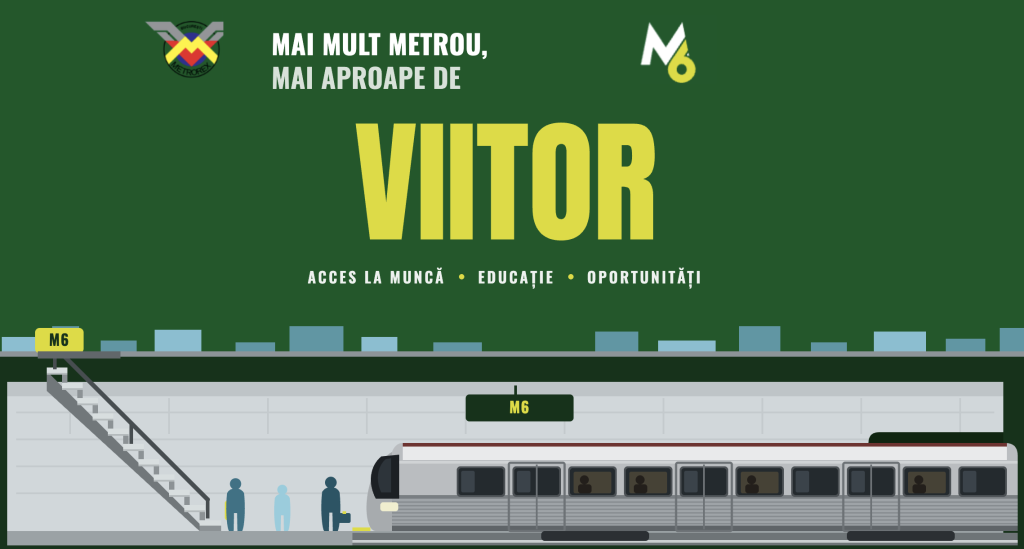
For a family in Otopeni or in the north of Ilfov county, the journey to Bucharest is not just a few kilometres on a map. It means mornings spent in traffic, time lost on the road, less hours with the family and, sometimes, opportunities that are harder to access.
That is why sustainability is not just about cleaner air, lower emissions or more efficient technical solutions. It means easier access to work, to school, to services and to the places where everyone builds their future.
Seen in that light, M6 Metro Line is more than just a metro line. It is a new connection between communities and the city, between home and workplace, between school and family, between the present and tomorrow’s opportunities.
Commuting is not just lost time
The daily journey to work or to school has a greater impact than it might seem at first sight. A study carried out by researchers Raj Chetty and Nathaniel Hendren at Harvard University, based on data from around 40 million people, has shown that commuting time is one of the most important factors associated with the chances of social mobility. The conclusion is that when people have access to reliable, predictable and affordable transport, they are more likely to secure better jobs, access education and essential services.
The same idea is also supported by mobility experts. The International Transport Forum, part of the OECD family, emphasises that the role of transport is to bring education, healthcare, jobs and everyday activities closer to people.
Quality transport does more than simply move people from one place to another. It gives them greater freedom of choice. It makes everyday life easier. It opens up routes that might otherwise seem too long or too difficult to travel.
A young community, growing fast
The area around M6 Metro Line is one of the most dynamic in Romania. Between the 2011 and 2021 censuses, Ilfov County recorded one of the highest population growth rates in the European Union, at around 40%. At the same time, Ilfov is the youngest county in Romania, with an average age of 38.6 years.
Behind these figures are people: young families, children, parents who work in Bucharest, pupils and students who commute every day, growing communities that need better connections with the city.
However, this development also brings challenges. More and more people are travelling between Ilfov and Bucharest every day, and the roads are becoming increasingly congested. For a pupil attending secondary school in the capital, for a student, or for a parent who works in the city, every hour spent in traffic is an hour taken away from their personal time, their leisure time, and their family life.
How M6 is making a difference to the community
This is where M6 Metro Line comes in. On the North Section, Lot 1.2 Tokyo – Aeroport Otopeni, the new metro line will connect the northern area of the capital and the town of Otopeni with the Bucharest metro network and with Henri Coandă International Airport.
Stations such as Bruxelles, Otopeni, Ion I.C. Brătianu and Aeroport Otopeni will bring high-capacity public transport closer to the communities that need it daily.
For the people living near the metro line, this means greater predictability. A teenager will be able to reach secondary school or university more easily. A parent will be able to get to work without depending constantly on the car or on road traffic. A family with a single car, or with no car at all, will have more options.
It also means more equitable access to opportunities. Because when public transport becomes more accessible and efficient, opportunities no longer depend so much on distance, traffic or whether or not one owns a car.
More than transport
The benefits of a metro line do not stop at the time saved on the journey. Modern transport infrastructure can support the development of the areas around the stations, encourage new services to appear, attract investments and connect the communities better.
Over time, the areas around the stations can become livelier, more accessible and better integrated into city life. Places where people do not just pass through, but live, work, learn and make plans.
A metro that brings people closer
M6 Metro Line is not just an investment in infrastructure. It is an investment in saved time, in easier access, in mobility and in better chances for the community.
Through this new link with Bucharest and with Henri Coandă International Airport, people in the northern area of the capital and in Otopeni will be closer to the places where they work, study and build their future.
Today we are building the infrastructure that will bring tomorrow communities closer to their opportunities. Because a sustainable city is, above all, a city in which people can reach one another more easily.














No Comments yet!