European Mobility Week 2026: the metro, beyond the platform

Metrorex has opened the Străulești Depot and the metro driver’s cab simulator at Valea Ialomiței station.

Between 16 and 22 September, around 3,000 towns and cities across Europe and beyond marked European Mobility Week, the European Commission’s campaign dedicated to sustainable urban transport. Bucharest and Ilfov concentrated their events on the weekend of 19-20 September, and Metrorex opened the Străulești Depot and the train driving simulator to the public.

A campaign that culminates in Car-Free Day

The “European Mobility Week” campaign takes place every year during the same week, 16-22 September, and concludes on 22 September with World Car-Free Day, when participating cities rethink the way their streets are used, making way for people rather than cars. This year, the organisers have maintained the 2025 message, ‘Mobility for All’, and added a new dimension: intergenerational equity. In short, transport must work for children, adults and older people alike.

At the launch of the campaign, the European Commissioner for Sustainable Transport and Tourism, Apostolos Tzitzikostas, said that the decisions we make today – how we travel, how we plan our cities, what we invest in – will determine the kind of mobility that future generations will inherit. The Commissioner took part in the events in Strasbourg and Thessaloniki as part of the CIVITAS Forum 2026.

Bucharest – Ilfov: historic trams, depot tours, the Presidential Train

In the Bucharest – Ilfov region, the programme was coordinated by TPBI, in collaboration with Bucharest City Hall and STB, with the participation of CFR and Metrorex. King Michael I Park served as the starting point for special routes to destinations in Ilfov and hosted bike rides and fanfare concerts. An exhibition of historic public transport vehicles was organised at Basarab Station, featuring special tram and trolleybus services. The STB depot and bus depot on Șoseaua Giurgiului welcomed visitors on guided tours, and at Gara de Nord the public were able to visit the Presidential Train, the Malaxa railcar No. 780, the Royal Salon and the CFR Museum.

Metrorex: #TogetherBeyondThePlatform

Metrorex has chosen to show the public what cannot be seen from the platform. Under the hashtag #TogetherBeyondThePlatform, two series of events were organised on Saturday and Sunday, between 10 am and 1pm, with limited places and advance booking required:

  • At the Străulești Depot, visitors stepped into an area not usually open to the public: the place where the metro trains are ‘based’. They discovered how a depot is organised, just how vast such a space is, and what goes on with the trains when they are not in service. For the youngest visitors, the Metrorex Museum at the Străulești Depot prepared a surprise: they took part in a fibre-optic workshop, where they had the chance to discover, in an interactive and fun way, some of the technologies that make metro transport systems possible.
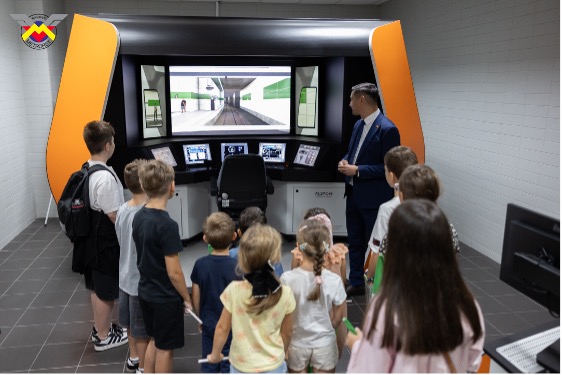
  • At Valea Ialomiței, at the metro train driver’s cab simulator, participants had the chance to experience a day in the life of a train driver and learn about the responsibilities of this profession. They were able to experience driving the train themselves in a simulated environment and learnt how drivers prepare and train to ensure the safe transport of passengers every day.

M6 Metro Line: the practical test of the European theme

M6 Metro Line is, in practice, Bucharest’s answer to the question asked by the European campaign: what kind of mobility are we giving to future generations?

The 1 Mai – Otopeni Line, comprising 14.2 km of double-track line and 12 stations, will connect the capital’s metro network to Henri Coandă International Airport. A metro line is built once and runs for decades: the line to Otopeni will be used by people who haven’t even been born yet and will take off the road cars that haven’t even been manufactured yet. For the child at the simulator’s controls, the journey to the airport will be a metro ticket; for their parents, a journey time they can rely on; for grandparents, a train they can reach without having to climb any stairs.

M6 is a project for Romania!
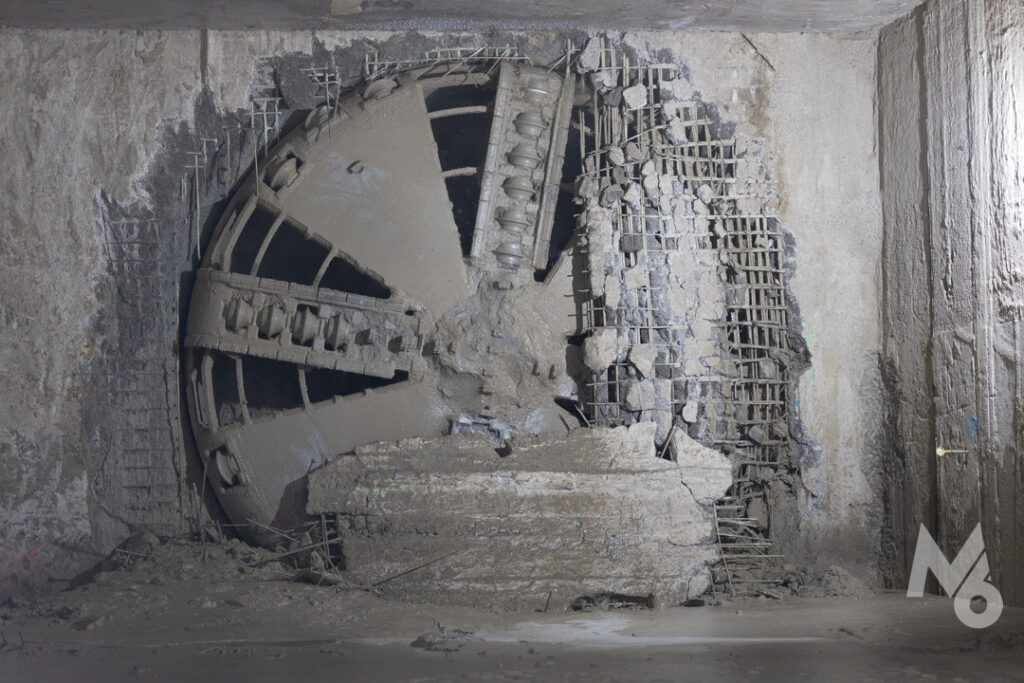
TBM “Sfânta Ana” breaks through the wall of the future Piața Montreal metro station

TBM “Sfânta Ana” broke through the wall of the future Piața Montreal metro station, today, on the alignment of the future M6 Metro Line.

The boring shield excavating the Line 1 tunnel on the SOUTH Section of M6 Metro Line has thereby completed the third tunnel segment on this line, running from the future Tokyo metro station towards 1 Mai station.

The double-track tunnel completed so far between the future Tokyo – Aeroport Băneasa – Gara Băneasa – Piața Montreal metro stations totals almost 3 km. On Line 1, TBM “Sfânta Ana” has excavated 2,838 linear metres and assembled 1,887 tunnel rings.

The length of the underground tunnel that TBM “Sfânta Ana” will complete as far as 1 Mai station is 6.6 km.

“We are content with the progress of works on M6 Metro Line. The breaking through of the wall at Piața Montreal station by TBM “Sfânta Ana” marks another important achievement in the construction of M6 Metro Line. The project is advancing at an efficient pace. M6 will provide a fast and modern connection between the metro network and Henri Coandă International Airport, contributing significantly to the development of urban mobility in Bucharest,” said Mariana MICLĂUȘ, Director General of Metrorex.

The “moles” digging the M6 metro: how a TBM builds the tunnel, ring by ring

The “moles” of M6 Metro Line dig the earth, bring it to the surface and build the tunnel behind them, almost simultaneously. Their technical name is TBM, from Tunnel Boring Machine.

The TBMs “Sfânta Maria” and “Sfânta Ana”, which are working on the SOUTH Section of M6 Metro Line, weigh around 600 tonnes and have cutterheads roughly 6.60 metres in diameter. In length, they come close to a football pitch. They enter the ground, and behind them they leave a circular, reinforced tunnel, ready for the next stages.

The front of the TBM carries the cutterhead, a huge metal disc fitted with cutting tools. It rotates, breaks up the ground and pushes the material into a chamber where the pressure is controlled at all times. The pressure keeps the excavation face stable and allows the machine to advance under control. From there, the material travels onto a screw conveyor, then onto conveyor belts, and out of the tunnel. It is loaded up and taken to authorised sites.

While digging goes on at the front, the tunnel is already being assembled behind the shield.

Segments and tunnel rings

The TBM advances using hydraulic rams that push against the last ring installed. After each advance, an erector lifts the segments, the precast concrete elements, and sets them side by side until a new ring is closed. A gap remains between the concrete ring and the ground, which is filled by injecting a special grout known as bentonite. The operation fixes the structure in place and helps stabilise the surrounding ground.

Then the cycle begins again: excavate, remove the material, advance the machine, install a ring, inject the grout. And so it goes, a few metres a day, month after month.

How the “mole” knows where to go

Tens of metres underground, orientation has nothing to do with instinct. The TBM has guidance systems, sensors and survey reference points tied to the project coordinates. The operators follow the alignment constantly and can correct the direction with very precise adjustments. From the control cabin they monitor, in real time, the pressure in the excavation chamber, the amount of material extracted and the position of the machine in relation to the designed axis. The operating parameters of the cutterhead and of the hydraulic systems, as well as the operations involved in fitting the rings are added to these are.

Under standard conditions, the TBMs on the SOUTH Section of M6 Metro Line in Bucharest advance at an average speed of approximately 1.5 metres per hour. It doesn’t seem like much, until you see what happens during that hour: the machine excavates around 60 cubic metres of material and prepares for the installation of the tunnel’s permanent structure.

An average of 13 to 14 rings are installed in 24 hours. The teams work in three shifts and the activity is continuous, with the breaks as required for checks and maintenance. The pace varies according to the ground, the recorded parameters and the maintenance work.

Romania’s “moles”: from the metro to tunnels through the mountains

TBM technology is not being used in Romania for the first time. On M5 Metro Line in Bucharest, the excavation was carried out by “Sfânta Varvara” and “Sfânta Filofteia”.

On the Brașov – Sighișoara railway line, on the Apața – Cața subsection, four TBMs are at work, “Eleni”, “Varvara”, “Alexandra” and “Konstantina”, on the Ormeniș and Homorod twin tunnels. The railway machines have a different diameter and work in different geological conditions, but the principle is the same: controlled excavation, removal of the material, immediate installation of the structure and monitoring of the parameters.

The names follow a long tradition in tunnelling projects. Saint Barbara is regarded as the protector of miners and of those who work underground. On M6 Metro Line, the tradition continues with “Sfânta Maria” and “Sfânta Ana”.

What happens at the surface

Although the activity takes place underground, the operation of the TBM is backed by an extensive monitoring system. The pressure in the excavation chamber, the amount of material extracted, the route of the machine and the soil characteristics are checked at all times. In the areas within the zone of influence of the works, special equipment is used to monitor the ground and the buildings.

The underground route to the airport

M6 Metro Line will have 14.2 kilometres of double track and 12 stations, and will create the first direct metro connection between Gara de Nord and Henri Coandă International Airport.

The video shows how the machine advances and how the concrete segments become, ring by ring, the structure of the future tunnel.

Press “Play” and step inside a TBM for a few minutes.