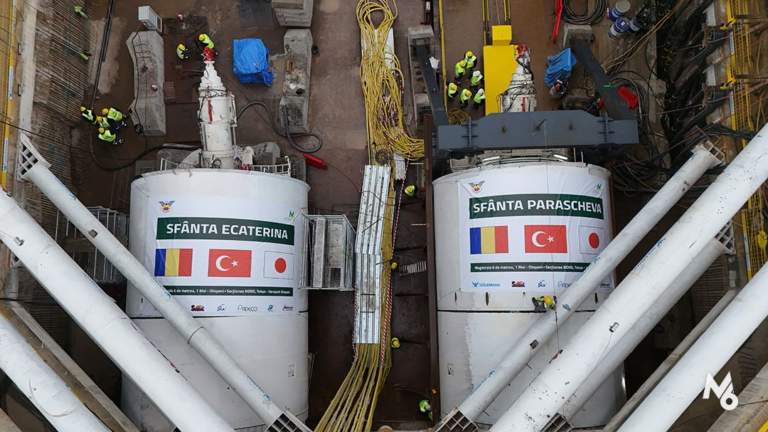
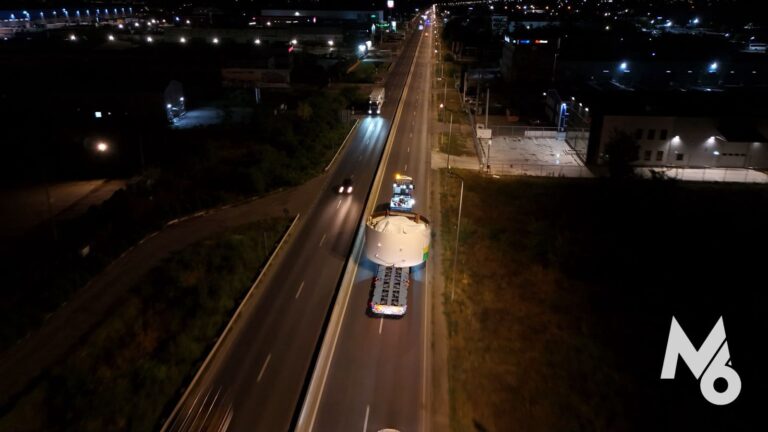
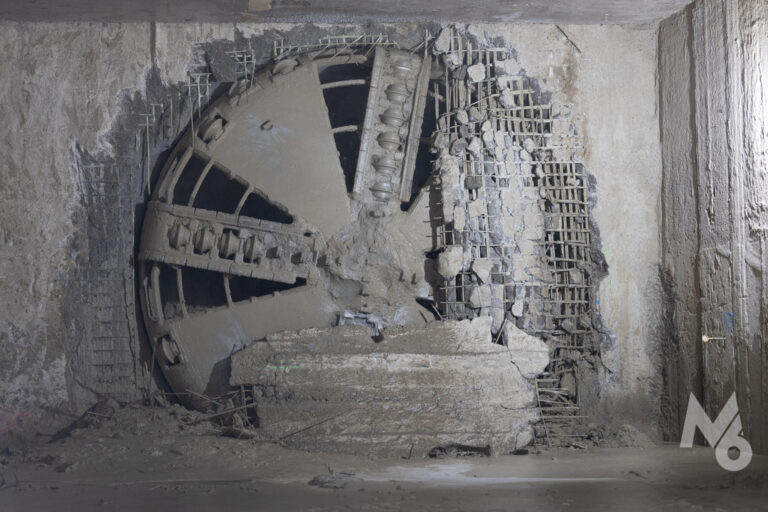


TBM launch ceremony
Technical information about the TBM

1. Tunnel face; 2. Cutter head; 3. Excavation chamber; 4. Main drive; 5. Propulsion cylinder; 6. Screw conveyor; 7. Erector; 8. Segment
The main components of the TBM
- Cutter head: supported by the pressure of the ground in the excavation chamber. It mixes the soil and the treated ground; openings in the cutter head let the excavated soil pass into the excavation chamber, where the required consistency is obtained using soil conditioners. The mixing blades ensure the excavated soil is mixed optimally.
- Main drive: provides the torque needed to rotate the cutter head, through electric motors and a mechanical bearing system.
- Shield: made up of 3 sections (front, middle and tail) housing the electrical, mechanical, ground-conditioning and hydraulic components; it guides the TBM, installs the segments and supports the ground to create a safe working zone.
- Back-up system (gantry): includes the auxiliary electrical and mechanical sub-systems that help the TBM advance through the tunnel.
- Segment erector: located behind the tail shield, it handles and assembles the segments of the permanent lining to build each ring.
- Airlock (SAS): made up of a hyperbaric chamber and an auxiliary chamber bolted to the front shield, designed for 3 people and a maximum pressure of 5 bar; it maintains the ground pressure during interventions and repairs.
- Articulation system: allows the TBM to keep advancing along the tunnel alignment, using the articulation and thrust cylinders.
- Operator cabin: equipped with the TBM software (PLC) system used to set the parameters and operate the machine.
- Propulsion cylinders: hydraulic cylinders with jack shoes that press against the rings already installed inside the tail shield, pushing the machine forward through the ground.
- Screw conveyor: regulates the amount of soil extracted and transfers it to the conveyor belt; its speed is adjustable so that a constant pressure can be maintained.
- Conveyor belt: moves the soil from the screw conveyor to the conveyor belts along the tunnel.
- Navigation data system: uses the project coordinates and the tunnel geometry to guide the TBM.
TBM “Sfânta Maria”

The TBM “Sfânta Maria”, which will bore the tunnel from the future Tokyo metro station to 1 Mai, on the alignment of Metro Line 6, is 97 metres long, weighs about 600 tonnes and has a 6.60-metre cutter head. The name comes from the proximity of 8 September – the feast of the Nativity of the Virgin Mary – in keeping with the tradition of naming TBMs after patron saints.
Questions / Answers
What happens after the TBM cutter head starts turning at the start from Tokyo station?
The TBM advances until its tail shield disappears into the tunnel. Mortar is then injected to fill the space between the installed ring and the diameter of the TBM excavation.
How does the TBM work after the start?
Until the full length of the TBM has entered the tunnel, it moves forward syncopically, i.e. intermittently.
How fast does it travel per hour?
At the beginning, it covers the first advance (1.5 m) in about 3–4 hours. After that, the normal pace is 1.5 m per hour.
How many cubic metres of earth does it bore per hour?
Theoretically, about 60 m3 of soil is excavated for every 1.5 m of advance.
What happens to the soil displaced by the TBM?
The excavated soil is transported to the excavated-material basin by conveyor belt, then loaded into trucks and taken to suitable storage areas.
What happens after it breaks through into the next station, Aeroport Băneasa?
The TBM begins a maintenance cycle, then continues drilling.
Will there be any vibrations or noise during excavation?
Noise may be heard or vibrations felt, especially at night.
How is the tunnel made?
As the TBM moves forward and removes the soil, tunnel rings consisting of six segments are assembled.
How many tunnel rings are installed in 24 hours?
Normally 13–14 rings per tunnel are planned to be installed in 24 hours, but the number can vary depending on ground conditions and machine operation.
How many tunnel rings are needed to reach Aeroport Băneasa station?
Between Tokyo metro station and Aeroport Băneasa there are 900 m of tunnel, requiring about 600 rings.
How is the TBM accessed during the operational period?
Access is limited to authorised personnel. Team transport is by MSV (Multi Service Vehicle) or via the staff walkway.
Are there dangers during excavation, or is it a safe technology?
The TBM follows a rigorous occupational safety protocol. The shield body does not touch the ground, ensuring a high degree of safety.
How are the tunnel rings transported?
The tunnel rings are transported by MSV (Multi Service Vehicle), which can carry up to 50 tonnes.
How many people operate a TBM?
Work is carried out in three shifts; between 12 and 14 people operate the TBM over a 24-hour period, with a total of around 180 people involved.